
The window of tolerance is the zone of nervous system arousal where you can feel your emotions, think clearly, and stay present, all at the same time [1]. Inside this zone, stress feels manageable. When we move outside the window of tolerance, the body shifts into survival mode.
For people who have experienced trauma, the window of tolerance can be narrower, and seemingly small triggers may activate you and push your nervous system outside it more quickly. This is one reason nervous system regulation and somatic work are at the heart of trauma-focused care. If you’re experiencing emotional dysregulation or related trauma symptoms, you’re not stuck. Recognizing your window of tolerance and knowing how to bring yourself back to it is a skill you can build.
Key Takeaways
- The window of tolerance is the arousal zone where you can think clearly, feel your emotions, and stay present.
- Above the window of tolerance, we may experience hyperarousal (anxiety, panic, racing thoughts); below it is hypoarousal (numbness, shutdown, disconnection).
- Early attachment, trauma, and chronic stress can narrow your window of tolerance, sometimes making you more reactive.
- Grounding, breathing, movement, and supportive relationships can help widen your window over time.

What Is the Window of Tolerance?
As mentioned earlier, the window of tolerance is the range of emotional and physical arousal where your nervous system stays responsive without becoming overwhelmed [1]. The term was introduced by psychiatrist Dr. Dan Siegel to describe the state where learning, connection, and clear thinking are possible [2].
Inside this window, you can handle stress, sit with difficult feelings, and respond to life rather than react to it. Emotions may feel intense at times, but they remain manageable.
Everyone moves in and out of this zone during an average day. The goal is not to stay perfectly calm all the time, but to notice when you have left the window of tolerance and know how to come back [1].
The 3 Zones of Arousal: Window, Hyperarousal, and Hypoarousal
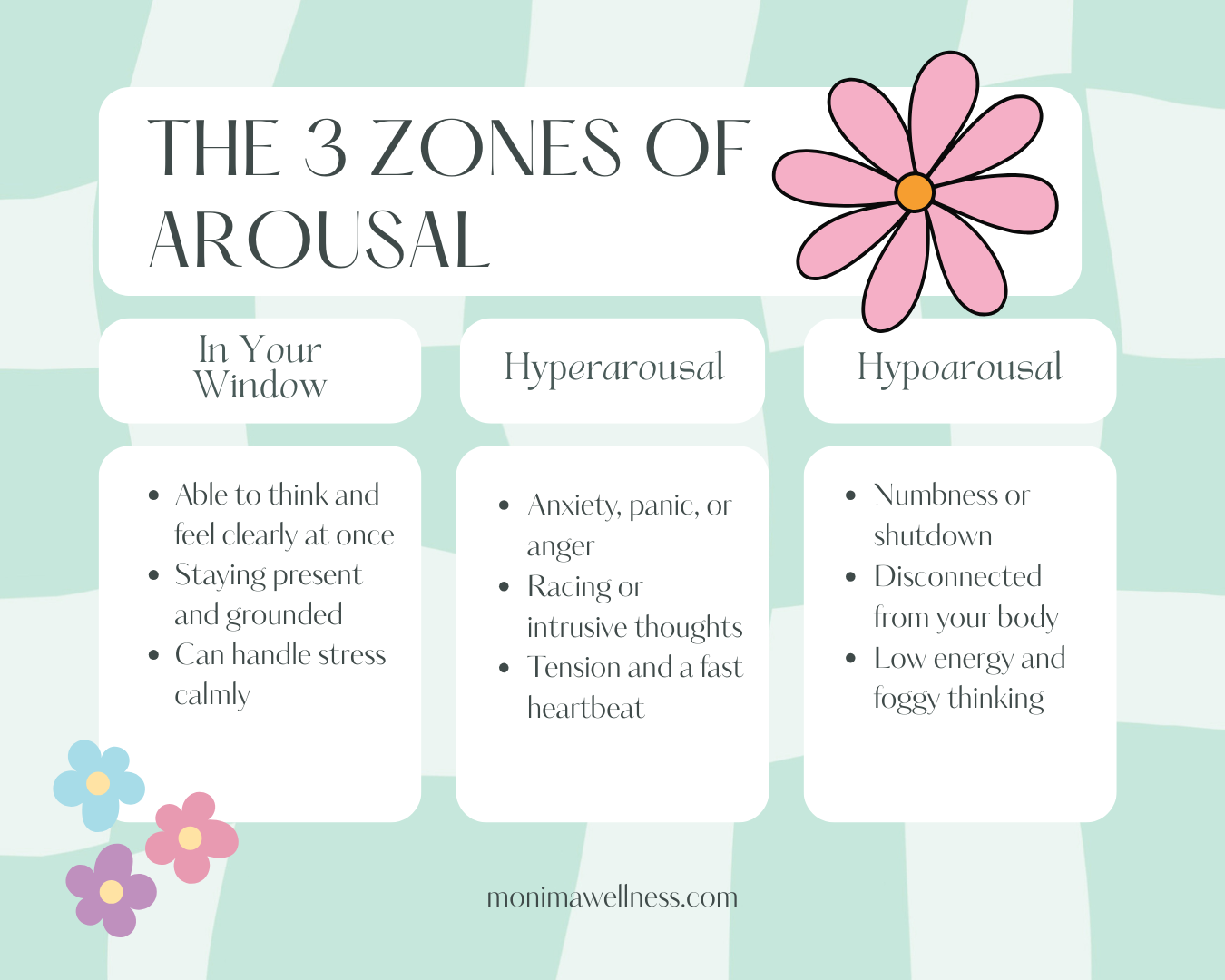
Your nervous system moves between three states, sometimes referred to as the three zones of arousal. Recognizing the signs of each can help you recognize where you fall in any given moment [5]. The three states are as follows:
Window of tolerance (regulated). You feel grounded and present. You can think and feel at the same time, set boundaries, and stay connected to others.
Hyperarousal (too much). The sympathetic “fight or flight” response takes over. Common signs include:
- Racing thoughts or intrusive images
- Anxiety, panic, or anger that feels hard to control
- Physical tension, a fast heartbeat, or feeling on guard
Hypoarousal (too little). The body shifts into shutdown. Common signs include:
- Numbness or a sense of feeling “dead” inside
- Disconnection from your body or your surroundings
- Low energy, fatigue, or trouble thinking clearly
Both hyperarousal and hypoarousal are your nervous system’s way of protecting you. At some point, these responses helped you cope with something overwhelming, even if they feel disruptive now [1]. They are not permanent, and with practice and support, the nervous system can heal and learn to regulate again.
What Narrows Your Window of Tolerance
Some people have a wide window and recover from stress easily, while others may have have a narrow window of tolerance. For these individuals, sometimes even small stressors can feel very overwhelming. Several factors can shape how wide or narrow your window of tolerance becomes [3].
Early attachment and childhood experiences can play a role in shaping our window of tolerance. For example, when a child does not have consistent, soothing caregiving, the nervous system may not fully learn how to regulate itself, which can lead to a narrower window in adulthood [3].
Trauma is also a factor. Overwhelming or repeated traumatic experiences can leave the nervous system quick to react, so it moves into hyperarousal or hypoarousal more easily [1]. Additionally, ongoing chronic stress, without enough time to recover, can gradually shrink the window over time [4].
Both hyperarousal and hypoarousal are your nervous system’s way of protecting you. At some point, these responses helped you cope with something overwhelming, even if they feel disruptive now [1]. They are not permanent, and with practice and support, the nervous system can heal and learn to regulate.
How the Window of Tolerance Affects Daily Life
Where you are in relation to your window of tolerance shapes how you function day-to-day. Inside your window, you can learn, solve problems, and connect with others [1].
Outside the window of tolerance, those actions become more difficult. In hyperarousal, it becomes hard to slow down, listen, or feel safe. In hypoarousal, motivation and focus fade, and you may feel detached from people or things you care about [1].
Outside your window of tolerance, the thinking part of your brain goes partly offline, so reasoning your way back to calm rarely works [3]. This is why regulation tools are so important: they allow your nervous system to settle, returning you to your window of tolerance so you can resume thinking clearly.
How to Widen Your Window of Tolerance
Widening your window of tolerance is possible, over time, with consistent practice and support [4]. The goal is to continue building your capacity to stay present with more of your emotions:
Several approaches can help widen your window of tolerance:
- Noticing your feet on the floor or naming objects around you brings attention back to the present.
- Slowing your exhale gently signals safety to the nervous system.
- Walking, stretching, or shaking out tension can shift both high- and low-arousal states.
- Co-regulation. Time with a calm, trusted person helps settle your system through connection [3].
Body-based and somatic approaches work directly with these tools and are central to regulating the nervous system after trauma.
When to Seek Trauma-Focused Treatment
Self-guided tools can be helpful, and they also have limitations. If you regularly feel stuck outside your window and unable to self-regulate, or if trauma, mental health concerns, or substance use are part of your story, working with trained clinicians can offer support that may feel more supportive than going it alone.
It may be worth reaching out if:
- Symptoms have lasted months or are getting worse
- Daily life, relationships, or work feel harder to manage
- A trauma history still feels unresolved
- Substance use feels tied to managing stress or emotion

How Monima Wellness Can Help
At Monima Wellness, we help women and female-identifying individuals build nervous system regulation through trauma-focused treatment in San Diego. Our PHP and IOP programs combine somatic therapies, holistic healing practices, and evidence-based trauma therapy like EMDR to support healing at a pace that feels safe for you.
If you would like to learn more or check your coverage, you can verify your insurance or call us at 858-500-1542 to talk through your options.
FAQs
The window of tolerance is the zone where you can feel your emotions and think clearly at the same time. Inside it, stress feels manageable, and you stay present. When you move above it, you feel anxious or overwhelmed, and when you drop below it, you feel numb or shut down. Learning to return to this zone is a skill you can build.
The 4 F’s refer to four common survival responses: fight, flight, freeze, and fawn. Fight and flight are high-arousal reactions, freeze involves a shutdown or immobilized state, and fawn describes appeasing others to stay safe. This is a popular framing that maps onto the nervous system’s fight-or-flight and shutdown states, though clinical research often describes these responses in slightly different terms.
You can widen your window of tolerance gradually through regulation skills and support. Grounding, slow breathing, gentle movement, and time with calm, trusted people all help your nervous system feel safe. Body-based and trauma-focused therapies build this capacity over time. Progress tends to be slow and steady rather than immediate, and professional guidance can help.
To move out of hypoarousal, gentle activation tends to help more than trying to relax further. Light movement, stretching, or a brief walk can raise your energy, while engaging your senses (noticing sounds, textures, or temperature) helps you reconnect with the present. Splashing cool water on your face can also increase alertness. If shutdown happens often, a clinician can help you build a plan.
No, the window of tolerance varies from person to person. Some people have a naturally wide window and recover from stress easily, while others have a narrower one shaped by early attachment, trauma, or chronic stress. Your window can also change over time. With practice and support, most people can widen their capacity to stay regulated.
[1] Corrigan, F. M., Fisher, J. J., & Nutt, D. J. (2010). Autonomic dysregulation and the window of tolerance model of the effects of complex emotional trauma. Journal of Psychopharmacology, 25(1), 17–25.
[2] Siegel, D. J. (1999). The developing mind: How relationships and the brain interact to shape who we are. Guilford Press.
[3] Raju, R., Corrigan, F. M., Davidson, A. J. W., & Johnson, D. (2012). Assessing and managing mild to moderate emotion dysregulation. Advances in Psychiatric Treatment, 18(2), 82–93.
[4] Larsen, K. L., & Stanley, E. A. (2021). Leaders’ windows of tolerance for affect arousal—and their effects on political decision-making during COVID-19. Frontiers in Psychology, 12, 749715.
[5] Vancampfort, D., Gillis, V., & Van Damme, T. (2026). How arousal regulation shapes our work with patients: A window of tolerance perspective for physiotherapy. European Journal of Physiotherapy, 28(3), 183–187.