
If you’ve been feeling stuck in anxiety, exhaustion, or a kind of tension you can’t quite explain, your nervous system may be at the center of it. Healing your nervous system means helping your body move out of a prolonged stress state and back toward a sense of safety and balance—and research confirms this is possible at any age, not just in childhood.
The process isn’t quick, and it isn’t one-size-fits-all. But it is real, and it starts with understanding what’s actually happening in your body. For women navigating trauma, anxiety, burnout, or substance use, outpatient mental health treatment that incorporates nervous system regulation can be an essential part of the healing process.
What to Know
- Trauma and chronic stress can leave the body stuck in what’s called survival physiology—a protective state that affects everything from muscle tension to decision-making.
- In this state, access to the part of the brain responsible for reasoning and perspective is limited, which is why dysregulation can feel so hard to think your way out of.
- Healing is gradual and happens through small, consistent, body-based practice—not cathartic breakthroughs or quick fixes.
- Neuroplasticity research confirms the nervous system can adapt and reorganize throughout adulthood.
- Those with trauma histories or co-occurring conditions may benefit most from structured professional support.
What Does It Mean to Heal Your Nervous System?
Your nervous system is always running in the background—tracking your environment, regulating your heart rate and digestion, and deciding whether you’re safe. It works through two main branches: the sympathetic system, which kicks in when you’re under threat, and the parasympathetic system, which brings you back to rest, connection, and recovery.
When chronic stress or trauma pushes these systems out of balance, the body can get locked into patterns of hyperarousal or shutdown. This isn’t a flaw—it’s the nervous system doing exactly what it was designed to do. The difficulty is when those protective responses outlast the original threat and begin interfering with daily life.
Susan Van Note, a Somatic Experiencing® Practitioner and Craniosacral Therapist at Monima Wellness, describes healing as a process of slow, gentle, consistent, titrated steps that help a person safely reconnect with their body and learn to recognize signs of regulation. It’s less about dramatic transformation and more about building familiarity with what safety actually feels like in the body—one small experience at a time.
What Causes Nervous System Dysregulation?
Dysregulation doesn’t require a single traumatic event. It can develop over time through chronic stress, relational difficulty, sleep deprivation, burnout, or substance use—any experience that keeps the nervous system in a prolonged state of alertness without adequate recovery.
As Van Note explains: “Trauma—whether from chronic mis-attunement, neglect, emotional abuse, or a single (or multiple) overwhelming event—can leave the body in what we call ‘survival physiology.’ This may show up as chronic tension, pain, digestive issues, a racing heart, shortness of breath, or multiple other symptoms.”
Common contributors for nervous system dysregulation include:
- Trauma or difficult childhood experiences
- Chronic stress, burnout, or emotional exhaustion
- Chronic illness, pain, or physical health challenges
- Grief, loss, or relational difficulty
- Substance use or withdrawal
- Living in an environment that feels unpredictable or unsafe
The nervous system responds this way for a reason—it’s trying to protect you. These patterns make sense given what the body has been through. The challenge is when they persist long after the original threat has passed.
What Does Nervous System Dysregulation Look Like?
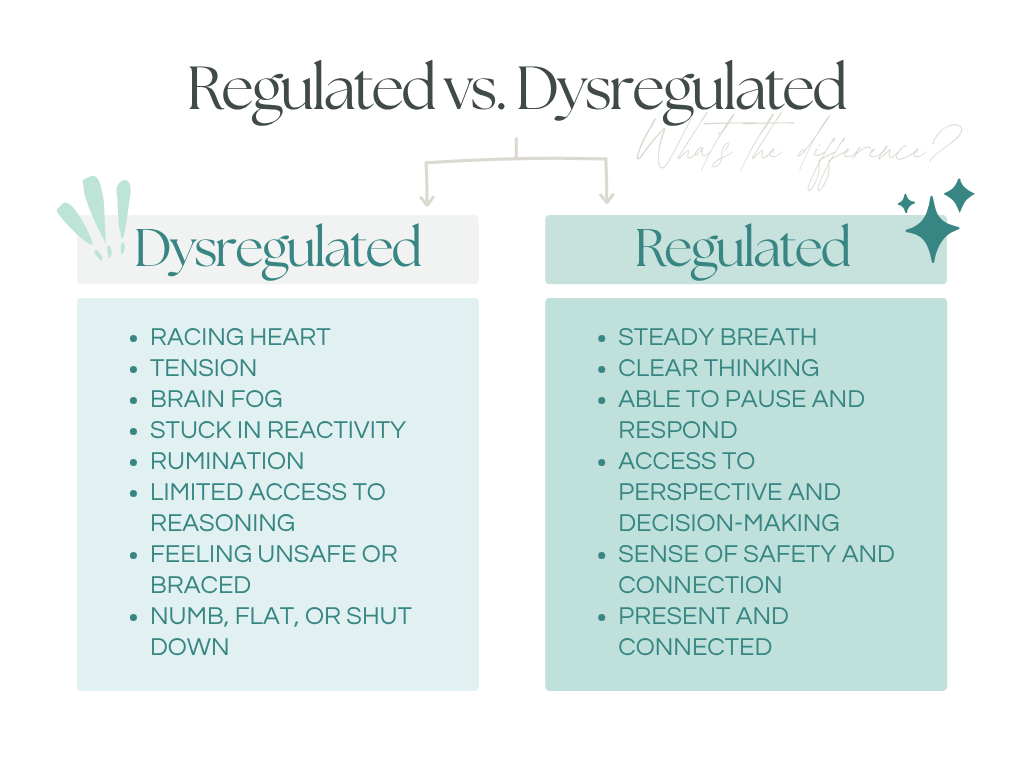
Dysregulation shows up differently for everyone. Some people feel stuck in overdrive—anxious, hypervigilant, easily startled, or unable to slow down. Others feel the opposite: flat, disconnected, exhausted, or emotionally numb. Many people move between both states without understanding why.
As Van Note explains:
“When fight or flight isn’t possible, the body often shifts into a braced, protective state. Many people live in this state for years or decades. In this survival mode, access to the cerebral cortex—the part of the brain responsible for reasoning, perspective, and healthy decision-making—is limited. Instead, people may feel stuck in reactivity and rumination.”
Physical, emotional, and behavioral signs often appear together:
- Persistent muscle tension, racing heart, or shallow breathing
- Difficulty sleeping or staying asleep
- Digestive problems, skin flares, or chronic fatigue
- Anxiety, panic, or persistent irritability
- Emotional numbness or difficulty feeling present
- Trouble concentrating or making decisions
- Withdrawing from relationships or social connection
These experiences can overlap with anxiety, depression, PTSD, and burnout—which is why they’re often misunderstood or misattributed.
If any of this sounds familiar, we’re happy to talk through what you’re experiencing and help you determine what support might be most helpful for you.
How Does Nervous System Healing Actually Work?
Healing the nervous system is a process of building new patterns—slowly, repeatedly, and through direct experience in the body. A 2025 review published in Brain Sciences confirms that neuroplasticity—the brain’s ability to adapt and reorganize—continues throughout adulthood, not just in early development. This means dysregulation is not a fixed state; the nervous system can learn new patterns given the right conditions.
Van Note describes what that shift can look like:
“As the nervous system begins to settle, access to higher-level thinking returns, and those physical symptoms associated with anxiety begin to lessen or disappear.”
But she’s equally clear about how that settling actually happens—and it’s worth sitting with, especially given how much nervous system content online promises dramatic breakthroughs or quick fixes:
“This process doesn’t happen as a huge cathartic moment, which can sometimes leave a person feeling overwhelmed. It happens through slow, gentle, consistent, titrated steps that help a person safely reconnect with their body and teach them to recognize signs of regulation.”

What Evidence-Based Practices Best Support Healing?
Several approaches have meaningful research support for nervous system regulation. They work through overlapping mechanisms: reducing stress hormones, strengthening the parasympathetic response, and supporting the brain’s capacity to build more flexible patterns over time.
1. Grounding and orienting.
Van Note points to this as a simple and powerful place to start. Her framing draws on the work of Dr. Peter Levine, the founder of Somatic Experiencing, who observed that animals in the wild don’t remain stuck in stress states—they naturally discharge and return to regulation. Van Note describes how this is practiced at Monima:
“We focus our awareness on our contact with the floor while sitting or lying down, then orient to the environment and track what changes internally—perhaps the breath deepens, the jaw softens, or a spontaneous sigh occurs. Practiced regularly, this helps build new, healthier neural pathways.”
Ready to try it? Van Note, a Somatic Experiencing® Practitioner who teaches nervous system regulation at Monima, has a free guided meditation—Grounding and Orienting to Calm Anxiety and Overwhelm—available on Insight Timer.
2. Controlled breathwork.
Slow, intentional breathing—particularly with extended exhales—directly activates the vagus nerve, the primary pathway of the parasympathetic nervous system. This signals safety to the brain and lowers cortisol and heart rate. Even a few minutes of daily practice can begin shifting baseline arousal over time.
3. Gentle, consistent movement.
Exercise metabolizes stress hormones and supports the production of brain-derived neurotrophic factor (BDNF), a molecule strongly linked to neuroplasticity and mood regulation. Walking, yoga, and swimming are well-suited to early nervous system recovery—accessible enough to be sustainable, and effective without adding stress to an already taxed system.
4. Sleep restoration.
The nervous system does significant repair during sleep, both physically and emotionally. Dysregulation often disrupts sleep, and disrupted sleep worsens dysregulation—a cycle worth addressing directly. Consistent sleep and wake times, reducing caffeine, and limiting screen exposure before bed are foundational starting points.
5. Somatic and body-based therapies.
Modalities like Somatic Experiencing, EMDR, IFS, and Cognitive Processing Therapy work with the body’s held patterns of stress and trauma. Rather than relying on insight alone, they engage the nervous system directly—helping people process difficult experiences and build greater capacity for regulation over time.
6. Nutrition and gut health.
The gut-brain axis plays a well-documented role in nervous system function. Gut microbiota produce neurotransmitters, including serotonin and GABA, that influence mood and brain activity. Regular, balanced nutrition—particularly foods rich in magnesium, omega-3 fatty acids, and fiber—supports this pathway and provides the nervous system with stable energy to draw on.
7. Safe relational connection.
When someone feels truly seen and safe in a relationship, their nervous system responds—this is called co-regulation, and it’s one of the most powerful tools for healing. This is why community is so important in recovery, not just as emotional support, but as actual medicine for the nervous system.

Healing the nervous system often goes deeper with consistent, structured support. If you’re curious about what that looks like, we’re happy to answer your questions. Get in touch.
When Should Someone Seek Professional Support for Nervous System Dysregulation?
Self-directed practices are beneficial, and they also have limits. For those navigating significant trauma histories, co-occurring mental health conditions, or substance use, a trauma-focused treatment program offers a unique kind of support. At Monima Wellness, nervous system regulation is a primary focus, and is woven into the treatment experience alongside somatic skill-building and a community of like-minded women.
Structured outpatient programs—like Partial Hospitalization (PHP) and Intensive Outpatient (IOP) programs—offer intensive support without requiring you to step away from your daily life. The combination of community, clinical care, and somatic work in these programs can reach places that weekly therapy alone often doesn’t.
It may be time to reach out if you’re experiencing:
- Symptoms that have lasted for months or are getting worse
- Difficulty keeping up with work, relationships, or daily routines
- A trauma history that hasn’t been fully addressed
- Substance use that feels tied to managing stress or emotional pain
- A feeling of being stuck, even when you’re trying
When Should Someone Seek Professional Support for Nervous System Dysregulation?
Self-directed practices are beneficial, and they also have limits. For those navigating significant trauma histories, co-occurring mental health conditions, or substance use, a trauma-focused treatment program offers a unique kind of support. At Monima Wellness, nervous system regulation is a primary focus, and is woven into the treatment experience alongside somatic skill-building and a community of like-minded women.
Structured outpatient programs—like Partial Hospitalization (PHP) and Intensive Outpatient (IOP) programs—offer intensive support without requiring you to step away from your daily life. The combination of community, clinical care, and somatic work in these programs can reach places that weekly therapy alone often doesn’t.
It may be time to reach out if you’re experiencing:
- Symptoms that have lasted for months or are getting worse
- Difficulty keeping up with work, relationships, or daily routines
- A trauma history that hasn’t been fully addressed
- Substance use that feels tied to managing stress or emotional pain
- A feeling of being stuck, even when you’re trying

Begin Your Nervous System Healing Journey
If what you’ve read here resonates, exploring next steps doesn’t have to feel overwhelming. Contact us or call 858-500-1542 to ask questions and learn what support might look like for you.
FAQs
A dysregulated nervous system can show up as persistent anxiety, panic attacks, chronic fatigue, trouble sleeping, brain fog, or feeling emotionally shut down. Physical symptoms like muscle tension, a racing heart, digestive issues, and frequent headaches are also common. These signs often overlap with conditions like PTSD, anxiety disorders, and depression, which is why talking to someone who understands the nervous system can help you make sense of what’s actually going on.
There’s no single timeline. Everyone’s nervous system has a different history, and healing moves at the pace that history allows. Some people start noticing changes in their sleep, their reactivity, or how they feel day to day within a few weeks of consistent practice. For others—especially those carrying complex trauma—it takes longer, and having professional support in that process makes a real difference. Healing isn’t really about speed. It’s about whether the right conditions are there to let it happen.
A dysregulated nervous system can look like feeling constantly on edge, hypervigilant, or unable to relax. It can also look like the opposite—flat, numb, disconnected, or chronically exhausted. Many people cycle between both. Digestive issues, disrupted sleep, physical tension, and difficulty being present in relationships are also common. These aren’t signs of weakness—they’re signs that your nervous system has been working hard to protect you.
It starts with consistent, body-based practice—breathwork, gentle movement, restorative sleep, and balanced nutrition all support regulation over time. Safe relationships matter too, since the nervous system is inherently social and responds to connection. For those that have experienced significant trauma or have co-occurring mental health conditions, an intensive program that weaves somatic skill-building into clinical care can make a meaningful difference.
Waxenbaum JA, Reddy V, Das JM. Anatomy, Autonomic Nervous System. [Updated 2025 Dec 1]. In: StatPearls [Internet]. Treasure Island (FL): StatPearls Publishing; 2026 Jan-. Available from: https://www.ncbi.nlm.nih.gov/books/NBK539845/
Tataranu, L. G., & Rizea, R. E. (2025). Neuroplasticity and nervous system recovery: Cellular mechanisms, therapeutic advances, and future prospects. Brain Sciences, 15(4), 400. https://doi.org/10.3390/brainsci15040400
van der Kolk, B. A. (2014). The body keeps the score: Brain, mind, and body in the healing of trauma. Viking.
Related Articles