
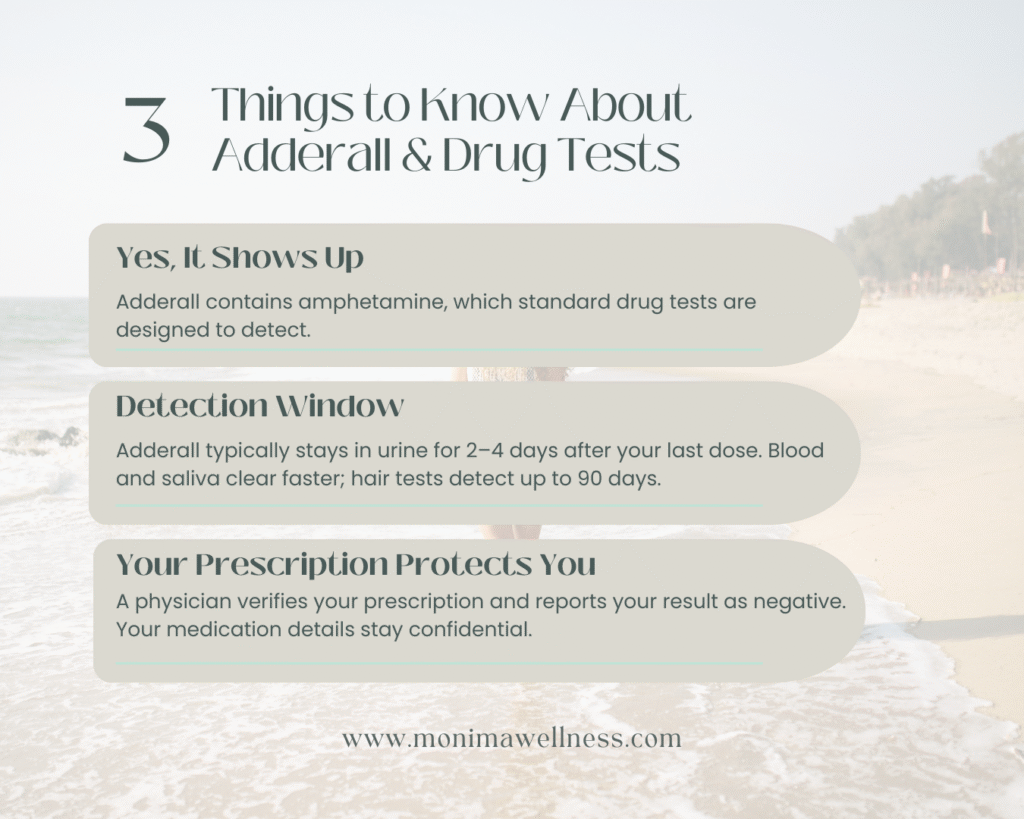
If you take Adderall for ADHD and have an upcoming drug test, you may be wondering whether your prescription will cause problems. The short answer is yes—Adderall will show up on standard drug tests because it contains amphetamine, a substance these tests are designed to detect. However, having a valid prescription typically protects you from negative consequences, as long as you understand the verification process.
For individuals managing both ADHD and substance use concerns, navigating drug testing can feel especially stressful. Understanding how the process works can help ease some of that anxiety and prepare you for what to expect.
If you or a loved one needs support with adderall addiction, Monima Wellness can help. Contact our compassionate team today to learn more about our empowering, holistic approach to mental health and substance use treatment.
Key Takeaways
- Adderall contains amphetamine salts and will trigger a positive result on standard drug screens
- A valid prescription protects you under most circumstances through a Medical Review Officer verification process
- Detection typically lasts 2–4 days in urine, though individual factors affect this timeline
- Non-stimulant ADHD medications like Strattera generally do not show up on drug tests
- Bringing prescription documentation to your test appointment may streamline the verification process
Why Adderall Triggers a Positive Drug Test
Adderall is a brand-name medication containing mixed amphetamine salts—specifically a 3:1 ratio of d-amphetamine and l-amphetamine. Standard workplace and medical drug panels screen for amphetamines as a class, which means Adderall will register as a positive result.
Most employment and medical drug tests use either 5-panel, 10-panel, or 12-panel screens. All of these include amphetamines among the substances detected. The initial screening test, called an immunoassay, works like a first-pass filter–meaning it can identify whether amphetamine-type substances are present in your urine, but it can’t tell the difference between prescribed Adderall and illicit amphetamine use.
When an initial screen returns positive, laboratories typically run an additional test, called a confirmatory test using gas chromatography-mass spectrometry (GC-MS). Think of this as a much more detailed analysis that can identify exactly which compounds are present and at what levels. This precision helps the reviewer verify whether your results are consistent with taking your prescribed medication, or whether other substances may be present.
How Long Adderall Stays Detectable
The length of time Adderall remains detectable depends on the type of test and various individual factors. Here’s a breakdown of detection windows for common testing methods:
Urine testing is the most common method for employment and medical screening. Adderall typically remains detectable in urine for 2–4 days after your last dose, though this can extend longer with regular use or higher doses.
Blood testing has a shorter detection window, usually up to 46 hours after the last dose. Blood tests are less common for routine screening but may be used in certain medical or legal contexts.
Saliva testing can detect Adderall for approximately 20–50 hours. This method is sometimes used for workplace testing due to its convenience and non-invasive collection.
Hair testing has a longer detection window, potentially identifying use for up to 90 days. Hair tests are less common and typically reserved for specific situations requiring a longer look-back period.
Fingernail testing offers the longest detection window, capable of identifying amphetamine use for 3–6 months after ingestion. Nail testing is relatively uncommon but may be used when hair testing isn’t possible or when documentation of long-term use patterns is needed.
Factors That Affect Detection Time
It’s important to note that not everyone metabolizes Adderall at the same rate. Several variables can influence how long the medication stays detectable in your system. Some of these include:
Dosage and formulation play significant roles. Higher doses take longer to clear your system, and extended-release formulations (Adderall XR) remain in your system longer than immediate-release versions. Research indicates that patients taking prescribed Adderall can have widely varying urine amphetamine concentrations, ranging from a few hundred to over 100,000 ng/mL depending on dosage and timing.
Individual metabolism affects the rate at which adderall stays detectable in your system. Kidney and liver function, age, body composition, and hydration levels all influence how quickly your body processes and eliminates the medication.
Urine pH can also impact detection for urine testing specifically. More acidic urine tends to increase amphetamine excretion, while alkaline urine may extend detection times.
Frequency of use matters as well. Someone who takes Adderall daily will likely have longer detection windows than someone who uses it occasionally.
What Happens When You Test Positive With a Prescription
Testing positive for amphetamines when you have a valid Adderall prescription doesn’t automatically create problems. The drug testing process includes safeguards specifically designed to protect people taking legitimate medications.
After a positive screening result, a Medical Review Officer (MRO)—a licensed physician responsible for reviewing drug test results—will typically contact you to verify your prescription status. MRO involvement is required for federal and DOT-regulated testing and is standard practice for most employers, though requirements vary by state and employer type.
Once your prescription is verified, the result is typically resolved in your favor. In testing programs that use an MRO, this verification happens confidentially—your employer usually receives only a negative or ‘cleared’ result without learning which medications you take. However, not all employers use MROs. In those cases, you may need to provide prescription documentation directly to HR or a hiring manager, which means less privacy protection. Either way, having your prescription documentation ready is essential for resolving a positive result.
How to Prepare for a Drug Test
Taking a few simple steps before your drug test can make the process smoother if questions arise about your results.
Bring documentation to your testing appointment. Having your prescription bottle, pharmacy printout, or physician’s contact information readily available demonstrates transparency and may expedite any verification needed.
Know your prescription details. Be prepared to confirm your prescribed dosage, frequency, and the name of your prescribing physician. Consistency between your reported information and pharmacy records helps establish compliance.
Don’t stop taking your medication specifically to pass a drug test, unless your physician advises otherwise. Abruptly discontinuing Adderall can cause withdrawal symptoms and may actually raise more questions if your prescription history shows recent fills but no medication is detected.
Understand the timeline. If you’re concerned about detection, knowing when you last took your medication and the typical detection window for your test type can help you anticipate results.
If you have questions about how your medication might affect an upcoming test, speaking with your provider can help you get more personalized guidance.
Legal Protections for Prescription Users
The Americans with Disabilities Act (ADA) generally protects employees who take legally prescribed medications for documented medical or mental health conditions. This means employers cannot discriminate against you simply because you take Adderall, or another stimulant, as prescribed for ADHD.
However, some exceptions do exist. Safety-sensitive positions regulated by the Department of Transportation (DOT)—such as commercial drivers, pilots, and certain transit workers—have additional requirements. In these roles, even prescription stimulant use may require specific clearances or alternative treatment arrangements.
If you believe you’ve experienced discrimination related to your prescribed ADHD medication, consulting with an employment attorney or filing a complaint with the Equal Employment Opportunity Commission (EEOC) are a few options available to you.
Do All ADHD Medications Show Up on Drug Tests?
Not all ADHD medications affect drug test results the same way. The key difference is whether the medication is a stimulant or non-stimulant.
Stimulant medications will show up on drug tests. These include Adderall (amphetamine/dextroamphetamine), Vyvanse (lisdexamfetamine), Ritalin and Concerta (methylphenidate), and Evekeo (amphetamine sulfate). These medications contain controlled substances that standard drug panels are specifically designed to detect, so they will trigger a positive result.
Non-stimulant medications generally won’t show up as amphetamines. Medications like Strattera (atomoxetine), Intuniv (guanfacine), and Wellbutrin (bupropion, sometimes used off-label for ADHD) work differently and aren’t flagged on standard tests. However, research has documented some cases where atomoxetine triggered a false positive on the initial screening test—but when the lab ran more precise follow-up testing, the result came back negative.
If you take a non-stimulant ADHD medication and receive an unexpected positive result, the more detailed follow-up test should clear things up. Letting the MRO know about all medications you take, including non-stimulants, can help ensure your results are interpreted correctly.
When Adderall Use May Require Additional Support
For most people prescribed Adderall, drug testing is straightforward—your prescription gets verified, and you move on. But sometimes, how someone uses their medication may point to a bigger picture that’s worth exploring.
Taking more than your prescribed dose, getting Adderall from friends or other sources instead of your pharmacy, or mixing it with alcohol or other substances can create both health risks and testing complications. If any of this sounds familiar, it might be worth reflecting on whether your current relationship with the medication is working for you.
It’s also not uncommon for people with ADHD to experience substance use challenges alongside their ADHD. It’s important to know that this isn’t a moral failing—ADHD affects impulse control and emotional regulation, which can make substances feel like an easy way to cope or find relief. When both ADHD and substance use are present, treatment that addresses both concerns together tends to be more effective than tackling them separately.
If your relationship with Adderall feels complicated, support is available. Our San Diego outpatient programs help women navigate ADHD, medication concerns, and substance use in a safe, nonjudgmental space. Connect with us to talk through your options.
Related Articles


You Deserve Support That Meets You Where You Are
Navigating ADHD, medication management, and the complexities that sometimes accompany them doesn’t have to feel overwhelming. If you’re wondering whether your relationship with Adderall or other substances might benefit from professional support, reaching out is a sign of strength.
Contact us to speak with our team of compassionate treatment specialists. You can also verify your insurance with our team. We will reach out to your insurance company and help you understand any potential out-of-pocket costs associated with treatment.
FAQs
Yes. Adderall contains amphetamine, which is one of the substances that standard drug tests are designed to detect. This includes common 5-panel, 10-panel, and 12-panel screens. If you have a valid prescription, a licensed physician called a Medical Review Officer will typically contact you to verify it. Once confirmed, your result is typically reported to your employer as negative—your specific medication details stay confidential.
In most cases, no. The Americans with Disabilities Act protects people who take legally prescribed medications for conditions like ADHD. Employers can’t refuse to hire you simply because you take Adderall with a valid prescription. That said, certain safety-sensitive jobs, like commercial truck drivers, pilots, and transit workers, have stricter federal rules that may affect whether stimulant medications can be taken.
Not all of them. Stimulant medications like Adderall, Vyvanse, and Ritalin will show up because they contain controlled substances. Non-stimulant options like Strattera (atomoxetine) generally won’t appear on drug tests. In rare cases, non-stimulants may trigger a positive on the initial screening, but more precise follow-up testing will clear that up.
Adderall is typically detectable in urine for 2–4 days after your last dose. The exact timeframe depends on several factors: your dosage, whether you take immediate-release or extended-release, your metabolism, kidney function, and how often you take the medication. Daily use may extend detection time compared to occasional use.
It helps to have your prescription bottle, a pharmacy printout, or your doctor’s contact information available. You don’t need to hand this over at the collection site, and you’re not required to disclose your prescription upfront. But if your test comes back positive and a physician needs to verify your prescription, having documentation on hand may make the process smoother.
Aronson, J. K. (Ed.). (2016). Dexamfetamine. In Meyler’s side effects of drugs (16th ed., pp. 881–882). Elsevier. https://doi.org/10.1016/B978-0-444-53717-1.00595-3
Contella, L., et al. (2025). Urine methamphetamine-to-amphetamine ratio by LC-MS/MS to differentiate methamphetamine use from pharmaceutical impurity in patients prescribed amphetamine. Journal of Mass Spectrometry and Advances in the Clinical Lab, 37, 49–55. https://doi.org/10.1016/j.jmsacl.2025.07.001
Substance Abuse and Mental Health Services Administration. (2017). Medical review officer guidance manual for federal workplace drug testing programs. U.S. Department of Health and Human Services. https://www.samhsa.gov/sites/default/files/workplace/mro-guidance-manual-oct2017_2.pdf
U.S. Equal Employment Opportunity Commission. (n.d.). The ADA: Your employment rights as an individual with a disability. https://www.eeoc.gov/publications/ada-your-employment-rights-individual-disability
Fenderson, J.L., et al. (2013). Amphetamine positive urine toxicology screen secondary to atomoxetine. Case Reports in Psychiatry, 2013, 381261. https://doi.org/10.1155/2013/381261