

Gaslighting is a repeated pattern of manipulation that leads you to doubt your own memory, perception, or judgment. It can happen in any relationship, whether it’s romantic, familial, or professional, and its long-term impact on mental health can be devastating.
Everyone misremembers a conversation now and then, and two people can walk away from the same argument with genuinely different versions of it. What sets gaslighting apart is that it keeps happening, and that your memory or your judgment is what keeps getting offered as the explanation [1].
A note on privacy: If someone may be checking your devices, the safest option is to read this on a phone or computer they can’t access, like one at a library or a friend’s. Browsing history can’t be fully erased, and incognito mode won’t hide activity from monitoring software. If you do clear your history, deleting select pages can draw less attention than wiping it completely.
The National Domestic Violence Hotline is available 24/7 at 800-799-7233, or text START to 88788.
In this article, we’ll explore common examples of gaslighting and highlight the key phrases often used by gaslighters to make you doubt yourself. Recognizing these signs can empower you to take control and seek the support you need.
If you’re struggling with gaslighting or emotional abuse, you’re not alone. Monima Wellness offers specialized intimate partner violence support for women in San Diego. Contact us today to speak to someone about your situation.
Quick Facts
- Gaslighting leads a person to doubt their own memory, perception, or sanity, usually in a way that benefits the person doing it.
- The most common tactics involve denying events, reversing blame, and changing the story depending on who is listening.
- Effects tend to fall on a spectrum, moving from confusion to persistent self-doubt and, in more severe cases, a loss of identity.
- Isolation from friends and family makes gaslighting more effective and considerably harder to recognize.
- Support is worth considering when the confusion starts following you into work, sleep, or your other relationships.

What Is Gaslighting?
Gaslighting is a manipulative tactic where someone makes you question your reality, memories, or feelings. It’s often done gradually, leaving the victim confused, anxious, and dependent on the gaslighter for their sense of reality. This form of emotional abuse can have severe effects on mental health, including anxiety, depression, and diminished self-esteem [2]. When the manipulation continues over a long period of time within close relationships, the impact can start to resemble that of complex trauma.
The term “gaslighting” comes from Patrick Hamilton’s 1938 play Gas Light, later adapted into the 1944 film, in which a husband systematically manipulates his wife into believing she’s losing her sanity [1].
Since then, the word has moved firmly into everyday language. Web searches for gaslighting rose 1,740 percent in 2022, the year Merriam-Webster named it word of the year [3]. That kind of popularity has come with a fair amount of confusion about what the term actually means.
The Psychology Behind Gaslighting
Research in clinical psychology points to several key mechanisms behind how gaslighting works [1]:
- Reality Distortion: Gaslighters systematically challenge the victim’s perception of events, creating confusion about what actually occurred
- Memory Manipulation: By consistently denying or altering facts, perpetrators cause victims to doubt their own recollections
- Emotional Invalidation: Victims’ feelings and reactions are consistently dismissed as inappropriate or exaggerated
- Dependency Creation: Over time, victims become increasingly reliant on the gaslighter’s version of reality
Research drawn from the accounts of survivors and support service providers has found that gaslighting rarely happens in isolation. It tends to show up alongside other forms of abuse, sometimes reinforcing them and other times working to conceal them, which is part of why the pattern can be so difficult to name [1].
Why Gaslighting Works on Otherwise Confident People
Part of what makes gaslighting so effective is that it depends on trust. We tend to rely on the people closest to us to help us make sense of our own experiences, and that reliance is exactly what gives a manipulative partner leverage over your read on what’s real [3].
There’s a second factor at play that makes this much harder to see from the inside. People are far less likely to revise their opinion of a close partner after bad behavior than they would be for an acquaintance or a stranger [3]. Accepting that you probably misremembered a conversation is, in a lot of cases, easier than accepting that someone you trust is lying to you.
Early behavior is also the hardest to recognize, since survivors often describe gaslighting as something that started slowly and picked up in frequency and intensity over time [1]. This is part of why love bombing so often comes first. That early intensity builds the trust that later gets used against you.
Isolation adds to the issue. When there are fewer people around to offer a different account of events, there are fewer opportunities to check your own perception against anyone else’s [3].
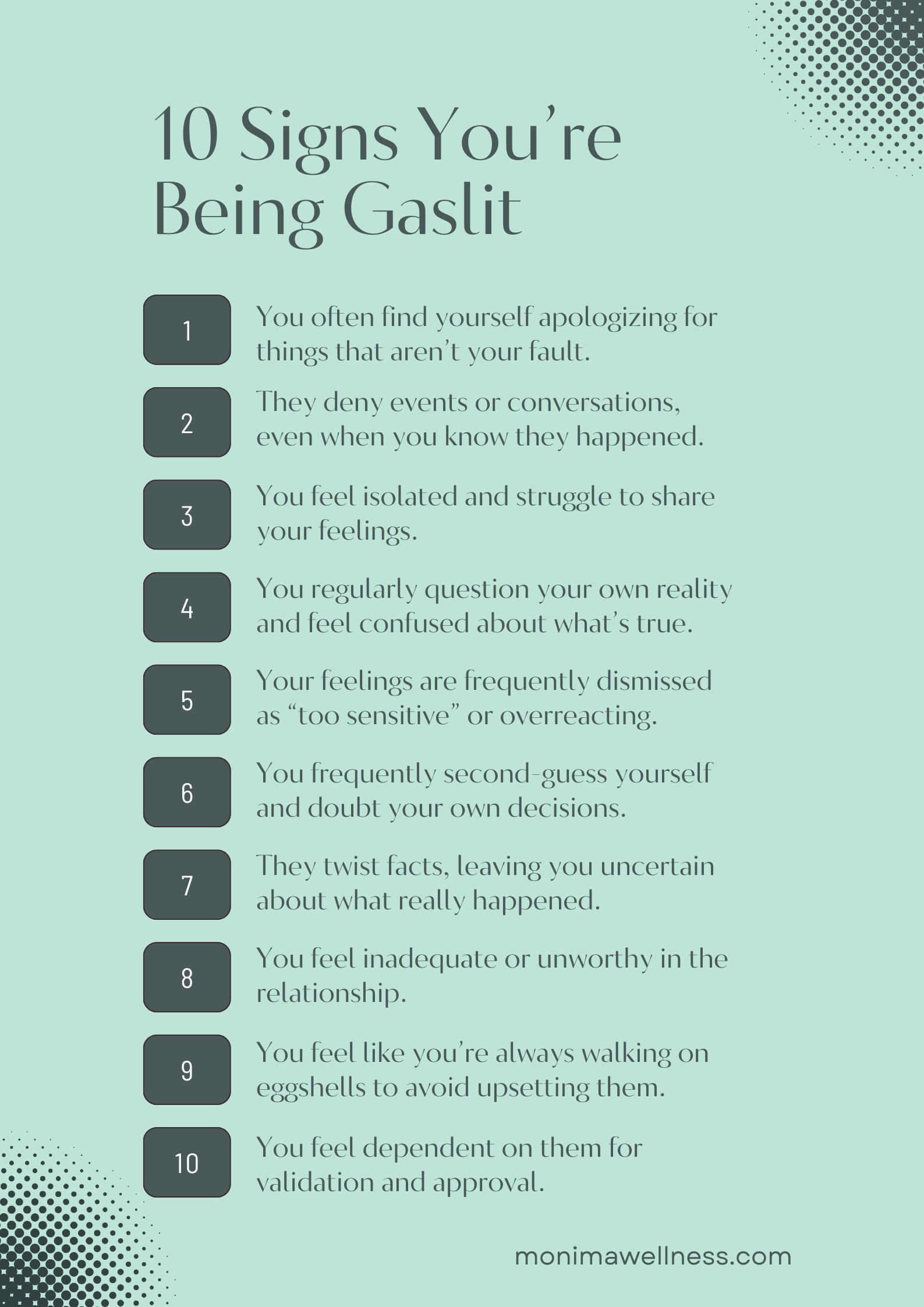
10 Common Gaslighting Tactics
As mentioned, gaslighting is a psychological manipulation tactic where someone distorts the truth, causing the victim to doubt their own perceptions, memories, or feelings. Below are ten common gaslighting examples that aim to undermine your sense of self and leave you questioning your reality.
When researchers looked at how survivors and support service providers actually describe gaslighting, the behaviors tended to cluster into a handful of recurring categories: denial and fabrication, reversing blame onto the victim, shifting the narrative depending on who is listening, isolation from outside perspectives, and drawing other people into the deception [1]. Nearly every example below is a version of one of those, which is worth keeping in mind as you read through them.
1. “That Never Happened”
One of the most common gaslighting tactics is flat-out denying something that did happen. When someone repeatedly says, “That never happened,” even though you remember it clearly, you second-guess your memory. Over time, this can leave you feeling unsure of what’s real and what’s not.
2. “You’re Too Sensitive”
Gaslighters often brush off your feelings by telling you you’re “too sensitive” or “overreacting.” This makes you doubt whether your emotional reactions are valid, and you might start to wonder if you really are being unreasonable. Spoiler alert: you’re not. It’s a tactic to make you feel small.
3. “You’re Imagining Things”
This is a classic way to make you question your perception of reality. When you bring up a concern, they dismiss it with, “You’re imagining things.” This can make you feel paranoid or even irrational as if you’re the one who’s wrong for even bringing it up. It chips away at your confidence in your own judgment.
4. “Everyone Else Thinks You’re Crazy”
An individual who is gaslighting you might try to make you feel isolated by claiming that other people agree with them. They might say something like, “All your friends think you’re crazy too.” This is meant to make you feel alone, with no one else to trust except them—even though they’re the person causing the problem.
5. “You’re Overthinking It”
Have you ever expressed a concern only to be told, “You’re overthinking it”? This is a tactic to make you second-guess your gut instincts. It makes you feel like you’re blowing things out of proportion, even when your concerns are valid.
6. Withholding Information or Refusing to Engage
Gaslighters sometimes refuse to engage in conversations about important issues or withhold information. When they say things like, “I don’t know what you’re talking about,” they’re avoiding accountability. This leaves you feeling confused and unsure about the situation because they’ve dodged the conversation altogether.
7. “It Was Just a Joke”
Ever had someone say something hurtful and then brush it off with, “It was just a joke”? This is a way for gaslighters to make you feel like you’re overreacting. It makes you question whether your feelings are valid, even when the comment was clearly inappropriate or mean-spirited.
8. Shifting Blame
Instead of owning up to their mistakes, gaslighters will often turn the tables and blame you. They’ll say things like, “This is all your fault,” or “You made me act this way,” making you feel responsible for their behavior. This tactic can leave you feeling guilty for things that aren’t even your fault, and it overlaps closely with reactive abuse, where your response to being provoked ends up getting treated as the real problem.
9. Contradictory Statements
A gaslighter might say one thing one day and completely deny it the next. For example, they could claim, “I never said that,” when you know they did. These mixed messages create confusion and make you question your own memory and understanding of the situation.
10. “If You Really Cared About Me, You Wouldn’t Even Think That”
This phrase uses your own love and care against you. The gaslighter might say, “If you really cared about me, you wouldn’t even think that,” making you feel guilty for expressing concerns. This emotional manipulation makes you question your own feelings and discourages you from standing up for yourself.
Gaslighting in a Sentence: How Manipulation Sounds in Real Conversations
Individual phrases can sound perfectly reasonable when you pull them out of context, which is part of what makes gaslighting difficult to recognize. The pattern becomes much easier to spot in full exchanges, where each response quietly moves the conversation away from what happened and toward whether you can be trusted to recount it.
Used in a sentence, the word tends to describe the pattern as a whole rather than a single remark: After two years, she realized her partner had been gaslighting her about nearly every argument they’d had.
Denying the event
You: “You told me you’d be home by seven.” Them: “I never said that. You’ve been really scattered lately.”
Reframing the harm
You: “That comment in front of your friends hurt.” Them: “It was a joke. You’re the one who made it awkward by reacting.”
Rejecting the evidence
You: “I have the text right here.” Them: “You’re twisting what I meant. You always do this.”
In each of these, the thing you originally brought up never actually gets addressed. What gets discussed instead is your memory, your reaction, or your motives.
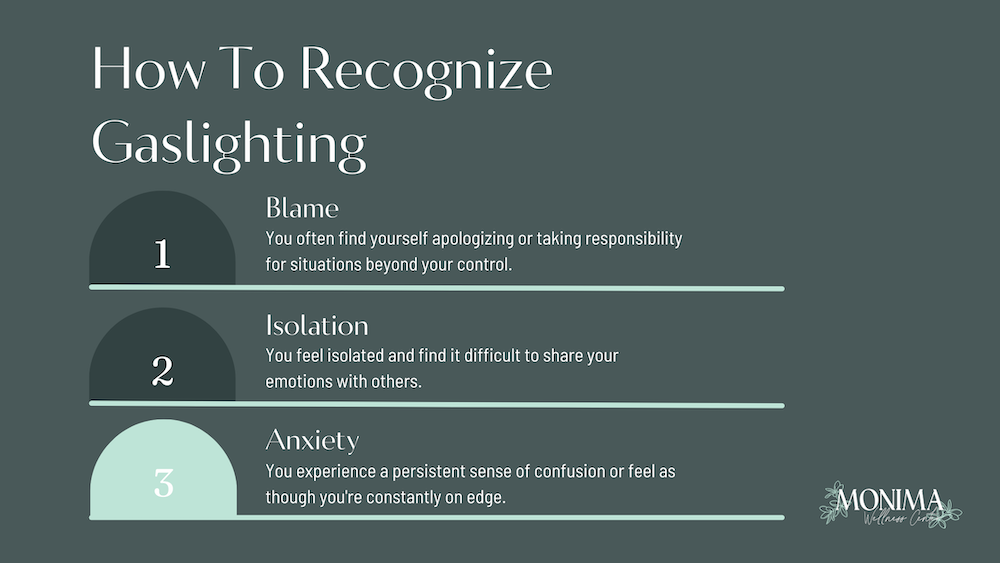
How to Recognize Gaslighting
Gaslighting is generally easier to see in patterns than in individual moments, which is why it can take so long to name. The clearest signal usually isn’t any one phrase, but a steady erosion of confidence in your own judgment that seems to happen around one particular person.
Common signs you’re being gaslit:
- You frequently apologize or feel responsible for things well beyond your control
- You feel isolated and unable to talk through your feelings with anyone else
- You feel like you’re “losing it,” or like you’re constantly walking on eggshells
- You second-guess decisions you would once have made without hesitating
- You keep notes or screenshots just to verify your own recollection
- You rely on that person’s approval to feel confident, even about small things
When Something Is Not Gaslighting
The term “gaslighting” has become common enough that researchers now list it among the most frequently misused words in psychology [1]. A few things can feel very similar without actually being gaslighting, and they’re worth separating out.
- Genuine forgetting. Two people can remember the same evening differently without either one manipulating the other. What tends to distinguish gaslighting is that one person’s account keeps shifting in their own favor, and that your reliability keeps being offered up as the reason for the discrepancy.
- Disagreement. Someone can disagree with you strongly, including about your own experiences and emotions, without gaslighting you [1]. The difference is that disagreement still leaves room for you to push back, whereas gaslighting tends to chip away at your standing to push back in the first place.
- Dismissiveness. Saying “I don’t want to talk about this right now” is avoidance, and while it may be frustrating, it isn’t the same thing as saying “that conversation never happened,” which replaces your account of events with someone else’s.
- A single incident. Both survivors and researchers consistently describe gaslighting as an ongoing pattern rather than a one-time exchange [1]. A single argument where someone rewrote history is worth paying attention to, but it isn’t enough on its own.
Intent is where the research gets the murkiest. Some researchers treat gaslighting as necessarily deliberate, while others argue it can happen without full awareness [1][3]. Research into personality traits and gaslighting suggests that it does tend to function as deliberate relationship control rather than a result of genuinely distorted perception [4]. One helpful approach, and the one that typically holds up best in practice, is to focus on whether the person knew, or reasonably should have known, that their behavior would cause harm [1].

Long-Term Mental Health Consequences
The effects survivors describe tend to fall on a spectrum. Confusion usually comes first, followed by a more persistent self-doubt, and in the most severe cases a loss of identity in which a person no longer trusts their own judgment enough to act on it independently [1].
Over longer periods, several patterns tend to show up:
- Complex Trauma: Chronic gaslighting can lead to complex trauma and Complex PTSD, particularly when it occurs in close relationships
- Attachment Disruption: Victims may develop insecure attachment patterns that affect future relationships
- Identity Confusion: Constant reality distortion can lead to fundamental uncertainty about one’s own identity and worth
- Emotional Dysregulation: Difficulty managing emotions and stress responses becomes common
Gaslighting has also been associated with emotional distress, diminished self-esteem, anxiety, and depression [2]. The effects of emotional abuse on women often persist well past the end of the relationship itself.
The Connection Between Gaslighting & Attachment Styles
Researchers have proposed that people with certain attachment styles may be more vulnerable to gaslighting relationships [3].
Those with anxious attachment patterns, often developed in childhood, may be particularly susceptible to manipulation tactics that exploit their fear of abandonment.
Understanding your attachment style can be an important step in recognizing unhealthy relationship patterns. Consider taking our attachment style quiz to better understand how your early experiences may influence your current relationships.
Common signs you’re being gaslit:
- You frequently apologize or feel responsible for things beyond your control.
- You feel isolated and unable to talk about your feelings with others.
- You feel like you’re “losing it” or constantly walking on eggshells.
If you recognize these signs, specialized support for women can help you regain clarity and rebuild your sense of self. Contact Monima Wellness today to begin your journey toward healing and reclaiming your mental well-being.

What To Do If You’re Being Gaslit
When dealing with gaslighting, it’s important to respond carefully and thoughtfully to protect your mental well-being. Here are a few tips:
- Get an outside perspective: Talk to someone who wasn’t involved. Researchers suggest that insight rarely arrives without an outside perspective from someone standing beyond the situation [3].
- Document incidents: Keep a record of specific instances when you feel gaslighted to ground yourself in reality.
- Don’t argue with the gaslighter: Arguing can be futile, as the gaslighting individual will often deny or twist facts.
- Build a support system: Talk to trusted friends, family, or a therapist who can help you validate your experiences.
- Trust yourself: Rely on your instincts, even if you’re being told otherwise.
What Healing Tends to Involve
Healing generally moves through two stages: first recognizing what actually happened, and then slowly rebuilding trust in your own judgment [3].
- Outside validation: Insight rarely arrives on its own. A trusted person, or a clinician, who can reflect back an accurate version of events is often what breaks the cycle
- Reconnecting with your body: Movement, creative work, and journaling all appear consistently in survivor accounts of recovery, largely because each one returns your attention to signals coming from you rather than from someone else [3]
- Attachment-focused work: Understanding how your early relationships shaped what feels normal to you can help you recognize the pattern much earlier next time. At Monima, attachment healing is woven through our women-only PHP and IOP programs.
The Importance of Professional Support For Survivors
Recovery from severe emotional abuse and gaslighting is often easier with professional support. The reality distortion that builds up in these relationships can be overwhelming, and support from an outside individual can help you separate manipulated perceptions from what actually happened.
Mental health and trauma treatment provides:
- External validation of your experiences
- Tools for rebuilding self-trust and confidence
- Strategies for recognizing and avoiding future manipulation
- Support for addressing any co-occurring mental health conditions
Support doesn’t have to mean stepping away from your life. Our women’s partial hospitalization program (PHP) and intensive outpatient program (IOP) provide structured, trauma-focused care five days a week without inpatient hospitalization or a residential stay. For women who don’t have a safe place to return to at the end of the day, or who are coming from out of state, we offer partnered housing throughout the length of your program.
Gaslighting in Different Settings
While gaslighting is most often discussed in the context of romantic relationships, it can occur in many different environments.
It’s also more common than most people realize. In a survey of 2,500 women who contacted the National Domestic Violence Hotline, 73.8 percent said a partner or ex-partner had deliberately done things to make them feel like they were going crazy [5].
Whether it’s happening at work, in friendships, or even within families, the impact can be just as damaging.

Let’s explore how gaslighting shows up in different areas of life:
1. Gaslighting at Work
In the workplace, gaslighting can take the form of manipulative behavior from supervisors or coworkers. For example, a manager might deny ever giving specific instructions, leaving you questioning your memory and competence.
If your boss repeatedly says, “I never asked you to do that,” despite clear evidence to the contrary, you may start doubting your ability to do your job. This kind of manipulation can affect your self-esteem and make you feel incompetent, even when you’re doing your best.
How to respond: Where you can, move important conversations to email so there’s a written record of what was actually agreed to. Keeping dated notes on specific incidents helps for the same reason. It’s also worth bringing a third party into project discussions early, and if the behavior starts affecting your work or your health, escalating to a manager or human resources is a reasonable next step.
2. Gaslighting in Friendships
Friendships can also be a breeding ground for gaslighting. A gaslighting friend might dismiss your feelings by saying things like, “You’re overreacting” or “You’re too dramatic,” whenever you bring up an issue.
Over time, you may start to question whether your emotional responses are valid or if you’re being unreasonable. This can create a toxic dynamic where the friendship feels one-sided, leaving you feeling invalidated and unsupported.
How to respond: Try naming the specific behavior rather than the person’s character, since that tends to leave more room for an actual conversation. Pay attention to what happens when you push back, because someone who can hear you is in a very different category from someone who doubles down. If the pattern holds after that, reducing contact is a reasonable response.
3. Gaslighting in Families
Gaslighting can also happen within families, where the emotional bonds can make it even harder to recognize. A family member might deny events from your childhood, saying, “You’re remembering it wrong,” or claim that certain painful experiences never happened.
This can lead you to doubt your own memories and question your perception of the past. When it’s coming from someone close to you, like a parent or sibling, this manipulation can be especially damaging, as it undermines your sense of identity and history.
Emotional abuse is among the most common forms of childhood maltreatment, and research links it to a greater likelihood of further traumatic experiences and more severe post-traumatic stress symptoms in adulthood [6].
How to respond: Where it’s possible, check your memory against siblings or others who were there at the time. It helps to decide in advance which topics you’re willing to engage with and which you aren’t. Getting acknowledgment often isn’t achievable, and holding onto your own account of what happened tends to matter more than winning agreement about it.
4. Gaslighting in Romantic Relationships
Of course, gaslighting is most commonly associated with romantic relationships. A partner might frequently deny things they’ve said or done, twist the truth, or blame you for their actions. For instance, they might say, “You’re imagining things” or “That never happened,” making you question your own reality.
Over time, this can erode your confidence, leaving you dependent on the gaslighter for validation.
How to respond: Keep your own record of the conversations that matter. Rather than debating whose account is accurate, state your own and leave it there without negotiating it. Maintaining at least one relationship outside the situation matters more than almost anything else here. If you feel unsafe at any point, prioritize your safety and reach out to a domestic violence resource.
5. Medical Gaslighting
Gaslighting can also happen in healthcare settings, where a provider dismisses symptoms rather than looking into them, and researchers have paid particular attention to the experience of female patients here [3]. It usually sounds something like “it’s all in your head,” “you’re too young for this to be anything serious,” or “you’re not a doctor.”
The effect is much the same as it is anywhere else. You walk out wondering whether you’ve been exaggerating something your body has been telling you fairly clearly.
How to respond: Ask that your concerns be documented in your chart, which creates a record even when the appointment doesn’t go the way you hoped. Bringing someone with you gives you a second set of ears. It’s also worth asking what would change the provider’s assessment, and seeking a second opinion when your symptoms persist.
How Monima Wellness Can Help

Gaslighting can distort your sense of reality, self-worth, and relationships. If any of these examples resonate, take the first step toward healing. At Monima Wellness, we help women break free from emotional manipulation, rebuild their confidence, and find peace through our trauma-focused PHP and IOP programs in San Diego.
If you’d like to learn more, call our compassionate team at 858-500-1542 or verify your insurance to get clarity around costs before you begin.
FAQs
A gaslighting apology shifts responsibility back to you while appearing to accept it. You’ll often hear versions like “I’m sorry you feel that way,” “I’m sorry you took it like that,” or “I’m sorry, but you made me react that way.” Each acknowledges your reaction rather than the behavior itself, leaving the original event unaddressed and quietly repositioning you as the problem.
Most tend to redirect rather than engage. Common reactions include denying the conversation happened, accusing you of overreacting, shifting to an unrelated grievance, or presenting themselves as the injured party. Because counter-accusation and blame reversal are core tactics, confrontation often ends with you defending yourself rather than getting the answer you were looking for.
The most effective approach is usually to stop arguing about whose version of events is accurate and simply state your own without negotiating it. It also helps to keep your own written record of what was said, and to bring in a perspective from someone outside the situation, since recognizing gaslighting rarely happens without that kind of input. If the pattern continues, limiting contact tends to work better than repeated confrontation.
Gaslighting is when someone repeatedly makes you doubt your own memory, perception, or sanity, until you start relying on their version of reality instead of your own. It usually shows up as denying things that happened, blaming you for their behavior, or telling you that you’re too sensitive to judge the situation accurately.
You may be experiencing gaslighting if you find yourself apologizing for things that aren’t your fault, second-guessing your memory after conversations with one particular person, or feeling confused about what actually happened. Other common signs include growing isolation from friends and family, keeping notes to verify your own recollection, and needing that person’s approval before you feel confident in your own judgment.
[1] Darke, L., Paterson, H., Dhillon, H., & van Golde, C. (2025). Defining gaslighting in intimate partner violence: Insights from victim survivors and support service providers. Psychology, Public Policy, and Law, 31(4), 375–392.
[2] Bellomare, M., Genova, V. G., & Miano, P. (2024). Gaslighting exposure during emerging adulthood: Personality traits and vulnerability paths. International Journal of Psychological Research, 17(1), 29–39.
[3] Klein, W., Wood, S., & Bartz, J. A. (2026). A theoretical framework for studying the phenomenon of gaslighting. Personality and Social Psychology Review, 30(2), 195–215.
[4] March, E., Kay, C. S., Dinić, B. M., Wagstaff, D., Grabovac, B., & Jonason, P. K. (2025). “It’s all in your head”: Personality traits and gaslighting tactics in intimate relationships. Journal of Family Violence, 40(2), 259–268.
[5] Sweet, P. L. (2019). The sociology of gaslighting. American Sociological Review, 84(5), 851–875.
[6] Gama, C. M. F., Portugal, L. C. L., Gonçalves, R. M., de Souza Junior, S., Vilete, L. M. P., Mendlowicz, M. V., Figueira, I., Volchan, E., David, I. A., de Oliveira, L., & Pereira, M. G. (2021). The invisible scars of emotional abuse: A common and highly harmful form of childhood maltreatment. BMC Psychiatry, 21, 156.