
Love bombing is a pattern of excessive affection, attention, and grand gestures early in a relationship, used to create closeness and dependence quickly. Mental health professionals describe this as a form of emotional abuse, though it does not always begin with conscious bad intentions [1].
What makes love bombing so difficult to navigate is that it can feel wonderful at first. Feeling amazing, yet quietly uneasy at the same time is often the first real sign that something might be off, or too good to be true.
Quick Facts
- Love bombing is intense, one-sided affection early in a relationship to build fast attachment and control.
- It is a recognized pattern of emotional manipulation, not a clinical diagnosis.
- Healthy affection is mutual and moves at a comfortable pace, while love bombing overwhelms and often ignores your boundaries.
- Love bombing has been linked with narcissistic traits, insecure attachment, and low self-esteem, though it is not always intentional.
- If a relationship leaves you anxious or isolated, that discomfort is worth listening to.
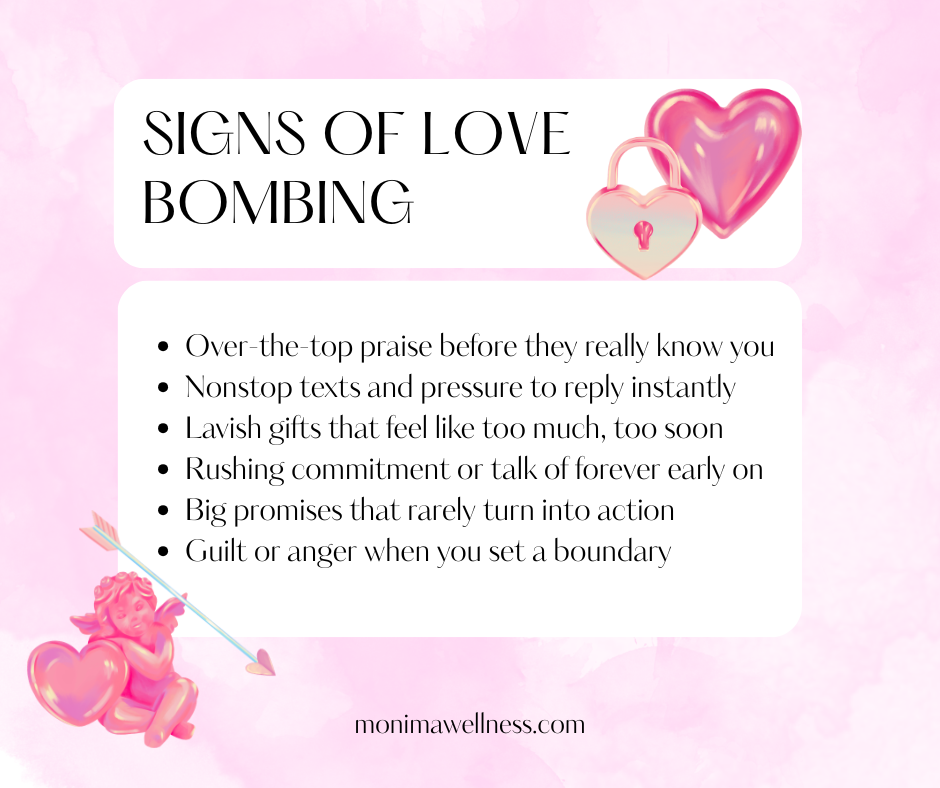

Common Signs of Love Bombing
Love bombing can be difficult to spot when you’re on the receiving end of it, because the attention feels good. Still, there are a few patterns that commonly show up together with this behavior:
- Excessive flattery: constant praise or talk of being soulmates very early on.
- Overwhelming contact: near-constant texts or calls with pressure to respond right away.
- Extravagant gifts: lavish or frequent gifts that feel like too much, too soon.
- Rushing commitment: early talk of marriage, moving in, or a shared future.
- Future faking: big promises and plans that rarely turn into follow-through.
- Disrespecting boundaries: sulking, pressure, or hostility when you ask for space.
Love Bombing vs. Genuine Affection
While the signs of love bombing might seem black-and-white, new love is usually exciting and maybe even all-consuming. So how do you tell the difference?
The most telling test is how the person responds when you slow things down or set a boundary. Genuine affection adjusts and respects your needs. Love bombing pushes back, guilts, or escalates.
It’s also important to remember that healthy interest is mutual and builds gradually, while love bombing feels one-sided and rushed. Additionally, a trustworthy partner’s actions match their words, while love-bombers have a habit of promising things they don’t deliver.
Why Does Love Bombing Happen?
Love bombing doesn’t have one single cause, and the person doing it may not even see it clearly themselves. However, research has linked love bombing tendencies with narcissistic traits, insecure attachment, and lower self-esteem [3].
This means someone may use intense affection to gain reassurance, control, or a sense of worth they struggle to get on their own.
When it comes to intent, this can also vary by person. Some people love bomb deliberately as a tactic, while others fall hard and fast because of their own anxiety or insecurity, without meaning to manipulate. Either way, being on the receiving end of it can be overwhelming.
The Idealization, Devaluation, and Discard Pattern
When love bombing is part of an abusive dynamic, it often moves through three stages [4].
- Idealization is the flooding stage, full of affection, praise, and talk of the future.
- Devaluation follows once you are attached. This is when criticism, control, or tactics like gaslighting typically begin to surface.
- Discard is the withdrawal stage, where the person pulls back or ends things, sometimes only to return and start the cycle all over again.
People with anxious attachment may be more vulnerable to love bombing. And when researchers looked at people who had been love bombed, their partners tended to rate higher for narcissistic traits [4].
How Love Bombing Can Affect You and What To Do
Being love bombed can create feelings of self-doubt, anxiety, trouble trusting your own judgment about people you’re dating, and even distance from friends and family.
If something feels off, that instinct is worth listening to. A few steps that can help:
- Name the pattern so you can make sense of what happened.
- If you’re still involved, set a small boundary and watch how the person responds.
- Lean on people outside the relationship for support and perspective.
- Go easy on yourself. Being love bombed is not your fault.
- Consider seeking professional support, especially if you feel isolated, unsafe, or stuck.

How Monima Wellness Can Help
If any of this feels familiar, you don’t have to navigate it alone. Monima Wellness offers holistic, trauma-focused care for women and female-identifying individuals, with an attachment-rooted approach that reaches the part of you that love bombing tends to affect most.
Our mental health PHP and IOP programs can help you build healthier relationships, steady your confidence, and trust yourself again.
Call 858-500-1542 or let us verify your insurance. We’re here when you’re ready.
FAQs
You are likely being love bombed if the affection feels overwhelming, one-sided, and often leaves you feeling pressured. Trust your body’s signals: uneasiness, walking on eggshells, or feeling like things are moving a bit too fast. It can also be helpful to see how this person responds when you set boundaries. Genuine care accepts boundaries and adjusts, while love bombing pushes back or escalates.
Common examples of love bombing might include daily extravagant gifts, nonstop texts with expectations of instant replies, and declarations of love or being soulmates within the first few weeks of meeting. It can also look like planning and discussing marriage or travel early on, or insisting on spending all your time together. The common thread is intensity that doesn’t align with how well you actually know each other.
The three-month rule is an informal guideline, not a clinical standard. The idea is that the intensity of love bombing typically fades around the two- to three-month mark, which is when criticism or control sometimes begin to surface. Some people use this idea as a reminder to give things time before making any major commitments.
Over text, love bombing often looks like a constant stream of messages, excessive compliments, and early, intense declarations of love. There is usually pressure to reply immediately, along with guilt-tripping when you don’t. The pace may feel rushed, and the content of the messages may focus more on locking in the relationship rather than genuinely getting to know you.
No, love bombing is not always intentional. Some people use it deliberately to gain control, while others move fast because of their own insecurity or anxious attachment, without meaning to manipulate. That being said, the intent doesn’t change the impact. If the intensity of a connection overwhelms you or crosses your boundaries, it’s worth noticing.
[1] Beri, R. (2024). A study on love bombing, narcissism and emotional abuse among young adults in relationship and situationship. International Journal of Interdisciplinary Approaches in Psychology, 2(6), 22–46.
[2] Centers for Disease Control and Prevention. (2022). The National Intimate Partner and Sexual Violence Survey (NISVS): 2016/2017 report on intimate partner violence. U.S. Department of Health and Human Services.
[3] Strutzenberg, C. C., Wiersma-Mosley, J. D., Jozkowski, K. N., & Becnel, J. N. (2017). Love-bombing: A narcissistic approach to relationship formation. Discovery, 18, 81–89.
[4] Goulden-Markusson, T. R. (2025). The illusion of affection: Unravelling the process of love bombing [Honours thesis, University of Regina].