
Fearful avoidant attachment is an insecure attachment style marked by wanting intimacy and fearing it at the same time. People with this pattern tend to hold a negative view of both themselves and others, so they crave closeness yet expect to be hurt or rejected by it.
Attachment styles usually trace back to early childhood experiences that shaped whether or not connection feels safe.
Curious about your attachment style? Take our attachment style quiz.
Quick Facts
- Fearful avoidant attachment combines a desire for closeness with a fear of it, driven by a negative view of both self and others.
- People with this style often cycle between seeking connection and pulling away, and tend to be highly sensitive to signs of rejection.
- Fearful avoidant attachment usually develops from early caregiving that felt inconsistent or frightening, though genetics and later experiences also play a role.
- Attachment styles are not fixed. With support, people can move toward more secure attachment.
- Trauma-focused and attachment-based care can help when these patterns affect daily life and relationships.

What Is Fearful Avoidant Attachment?
Fearful avoidant attachment is one of four attachment styles researchers use to describe how people relate in close relationships. The other three are secure, preoccupied (also called anxious), and dismissive (also known as avoidant).
Psychologists Kim Bartholomew and Leonard Horowitz mapped these styles along two dimensions: how a person views themselves and how they view others. Fearful avoidant individuals hold a negative perception of both. According to the research summarized in the Archives of Sexual Behavior, those with fearful avoidant attachment desire intimacy and fear rejection, yet remain deeply mistrustful of others, so they avoid the very closeness they long for. [1]
This style is unique because it carries traits of other attachment styles (both high anxiety and high avoidance) at the same time. For example, preoccupied attachment involves anxiety or fear of abandonment, and dismissive attachment involves avoiding intimacy. Fearful avoidant attachment holds both together, which is why it’s sometimes referred to as disorganized attachment in children.
What Fearful Avoidant Attachment Feels Like
For those living with it, fearful avoidant attachment often feels like an internal battle they can’t resolve. For example, they may deeply want a partner’s reassurance, then feel uneasy or trapped when they get it.
This core experience is a cycle. Closeness triggers a longing to connect, followed by a fear that connection will lead to getting hurt. So the individual may reach out, then withdraw, sometimes within the same conversation.
People with insecure attachment also tend to be more emotionally reactive. Research using brain-activity measures has found that individuals with insecure attachment styles show heightened sensitivity to emotional feedback and greater difficulty regulating those reactions compared to securely attached people. [2] This means even small signs of disapproval can have a stronger impact that lasts longer.
Signs of Fearful Avoidant Attachment
Fearful avoidant attachment shows up in patterns rather than moments. Recognizing these patterns is typically the first step toward understanding yourself and your emotions and reactions better.
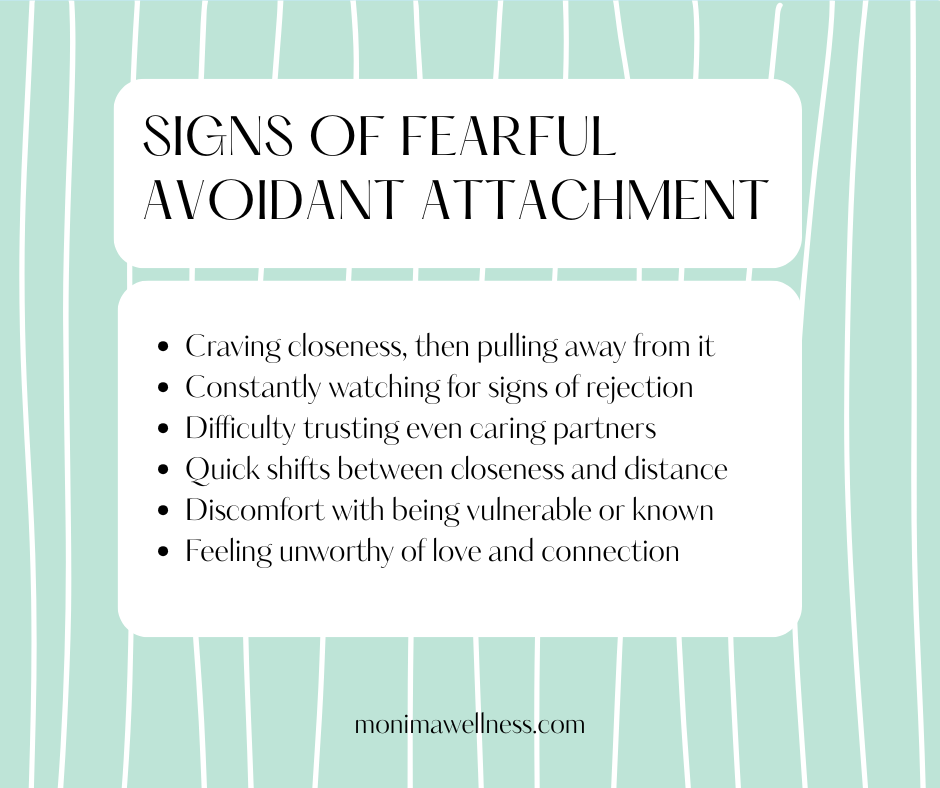
Common signs of fearful avoidant attachment may include:
- Craving closeness, then sabotaging it. You seek connection but pull away when it deepens.
- Hypervigilance to rejection. You scan for signs a person is pulling away and reacting strongly when you identify them.
- Difficulty trusting. Even in caring relationships, you expect to be let down.
- Emotional swings in relationships. Feelings toward a partner can shift quickly between longing and wanting distance.
- Discomfort with vulnerability. Sharing feelings can feel unsafe, so you may keep parts of yourself hidden.
- A harsh inner view of yourself. You may feel unworthy of love while also doubting whether others can be relied on.
Not everyone with this attachment style experiences all of these, and having a few does not mean you have fearful avoidant attachment. If you are trying to recognize your own patterns, a trained professional is always the best next step.
What Causes Fearful Avoidant Attachment
Attachment styles form early and are shaped by how caregivers respond to a child’s needs. According to attachment theory, developed by John Bowlby and Mary Ainsworth, warm and consistent caregiving tends to foster security, while harsh, cold, or inconsistent caregiving is associated with insecure attachment. [3]
Fearful avoidant attachment is often linked to caregiving that felt frightening or unpredictable. When the person a child turns to for comfort is also a source of fear or confusion, the child is left without a clear strategy. The result can be a pattern of both seeking and avoiding closeness that carries into adulthood.
It’s important to note that attachment is influenced by more than just early caregiving. Genetics and adult relationship experiences can also shape attachment, and research shows that these patterns can shift over time.
Can Fearful Avoidant Attachment Change?
Yes. Attachment styles are patterns, not permanent traits, and they can become more secure with reflection and support.
Bowlby described development as a set of possible pathways rather than fixed stages. A person shaped by difficult early experiences can still shift toward a more secure way of relating to others, especially through relationships that feel safe and consistent. Notably, research on caregivers found that people who had unhappy childhoods but were able to make sense of those experiences formed secure bonds in relationships, suggesting that reflection and processing matter as much as childhood experiences. [3]
Therapy is one of the most direct paths toward this kind of healing. Attachment-focused approaches help people understand the beliefs they may hold about themselves and others, then build new experiences of trust in a supported setting. [4] For fearful avoidant patterns specifically, this often means working with both the fear of closeness and the longing for it.

How Monima Wellness Can Help
If you’re feeling overwhelmed by challenging relationship patterns, you don’t have to go thorugh it alone. Monima Wellness offers trauma-focused, attachment-based care for women and female-identifying individuals in San Diego, delivered through supportive outpatient programs designed to help you understand and heal attachment at a deep level.
To learn more or ask questions, call 858-500-1542, or let us verify your insurance to begin the conversation.
FAQs
Signs include craving closeness but pulling away when it gets more serious, strong sensitivity to rejection, difficulty trusting others even in caring relationships, and quick emotional shifts between craving connection and wanting distance. People with this style often struggle with vulnerability and may hold a critical view of themselves.
It often feels like an internal struggle. You want reassurance and closeness, then feel anxious or trapped once you have it. The experience tends to cycle between reaching out and pulling away, sometimes all in a single interaction. Because insecure attachment is linked to heightened emotional reactivity, small signs of disapproval can feel intense and difficult to shake, even when a relationship is going well.
Fearful avoidant attachment is often described as the most challenging, because it combines both high anxiety and high avoidance. A partner may seek closeness and then push it away, which can feel confusing to people in their lives. With understanding and support, these patterns can shift toward greater security over time.
Yes. People with fearful avoidant attachment often love deeply and long for connection. The difficulty is not an absence of love but a fear that closeness will lead to hurt, which can cause them to withdraw or seem distant.
Attachment styles are not permanent and can become more secure with support. Therapy, especially attachment-focused and trauma-focused approaches, helps people understand their patterns and build new experiences of trust. Safe, consistent relationships can also help. Many people who reflect on and process difficult childhood experiences develop a more secure attachment style later in life.
[1] Zakreski, E., Jahnke, S., Androvičová, R., Bártová, K., Chronos, A., Krejčová, L., Martinec Nováková, L., & Klapilová, K. (2025). Preoccupied and Fearful-Avoidant Attachment Styles May Mediate the Relationship Between Poor Parental Relationship Quality and Sexual Interests in Violence. Archives of Sexual Behavior, 54(7), 2445–2461.
[2] Zuckerman, I., Laufer, I., & Mizrahi, D. (2023). Attachment style, emotional feedback, and neural processing: investigating the influence of attachment on the P200 and P400 components of event-related potentials. Frontiers in Human Neuroscience, 17, 1249978.
[3] Bowlby, J. (1988). A Secure Base: Clinical Applications of Attachment Theory. Routledge.
[4] Brown, D. P., & Elliott, D. S. (2016). Attachment Disturbances in Adults: Treatment for Comprehensive Repair. W. W. Norton.