
Compassion fatigue is a state of emotional, mental, and physical exhaustion that can develop after prolonged exposure to other people’s pain, distress, or trauma. It’s most common in caregivers and helping roles, including healthcare workers, therapists, parents, and those supporting loved ones through illness or crisis. Rather than reflecting a lack of care, compassion fatigue is often a sign of deep empathy combined with chronic stress and limited recovery time.
Over time, this strain can dull emotional responsiveness, reduce a sense of meaning in caregiving, and make it harder to show up with the same presence or patience as before. Many people experiencing compassion fatigue also recognize overlaps with healthcare burnout, especially when workplace demands and emotional labor collide. Support for healthcare burnout and emotional exhaustion can be an important part of recovery when compassion fatigue is work-related.
Importantly, compassion fatigue is not a personal failure. It’s a nervous system response to sustained emotional load, and it can happen even to people who are skilled, committed, and deeply compassionate.
Key Takeaways
- Compassion fatigue is exhaustion caused by ongoing exposure to others’ suffering.
- It often affects caregivers, healthcare professionals, and highly empathetic people.
- Symptoms can include emotional numbness, irritability, and physical fatigue.
- Early support and nervous system recovery can prevent longer-term impact.
How Compassion Fatigue Develops
Compassion fatigue develops when the stress response is repeatedly activated without adequate time or support for recovery. When someone is consistently attuned to others’ pain, their nervous system may remain in a heightened state of alert. Over time, this can lead to depletion rather than resilience.
Several interconnected factors tend to contribute. Emotional exposure to trauma or distress plays a central role, particularly when stories or experiences are intense, personal, or ongoing. Limited boundaries, such as difficulty separating work or caregiving roles from personal life, can intensify the strain. A lack of emotional processing, rest, or support further increases vulnerability.
The progression often unfolds across identifiable stages. Initial compassion and engagement may gradually decline as workload increases and rest time decreases, eventually leading to emotional discomfort, distress, and ultimately fatigue if support and recovery are not accessible.
Unlike ordinary tiredness, compassion fatigue affects both emotional capacity and physical regulation. People may notice they feel “shut down,” overwhelmed, or disconnected even when they want to care. Recognizing these mechanisms can help reduce shame and clarify why recovery often requires more than simple rest.
If this pattern feels familiar, speaking with a professional about stress and emotional overload can help clarify next steps.
Compassion Fatigue vs. Burnout: What’s the Difference?
Although compassion fatigue and burnout are often discussed together, they are not identical. Burnout is typically driven by workload, systemic pressure, and role demands, such as long hours, lack of control, or organizational stress. Compassion fatigue is driven more by emotional exposure—the cost of caring deeply for people who are suffering.
Another key difference is how they unfold. Burnout usually develops gradually over time, while compassion fatigue can emerge more suddenly, sometimes after a specific event or accumulation of emotionally intense experiences. Burnout often shows up as disengagement from work itself, while compassion fatigue more directly affects empathy and emotional availability.
That said, many people experience both at once, especially in healthcare or caregiving roles. When they overlap, recovery often involves addressing both systemic stressors and emotional processing needs.
What Are Common Signs of Compassion Fatigue?
Compassion fatigue can affect emotional, cognitive, and physical well-being. These reactions vary from person to person, but they tend to cluster into a few recognizable patterns.
Common signs include:
- Emotional numbness, detachment, or reduced empathy
- Increased irritability, cynicism, or impatience
- Persistent fatigue that doesn’t resolve with rest
- Difficulty concentrating or feeling mentally foggy
- Physical symptoms such as headaches, muscle tension, or sleep disruption
These signs don’t mean someone no longer cares. In many cases, they reflect a protective response—an attempt by the nervous system to conserve energy after prolonged emotional output. Research indicates that compassion fatigue can appear differently from person to person, with symptoms ranging from subtle to overt and fluctuating day-to-day.
If these symptoms are ongoing or worsening, connecting with support can help prevent further depletion.
What Are the Five Stages of Compassion Fatigue?
Compassion fatigue is often described as unfolding in stages, though not everyone experiences them in a linear way. Understanding these stages can help with early recognition.
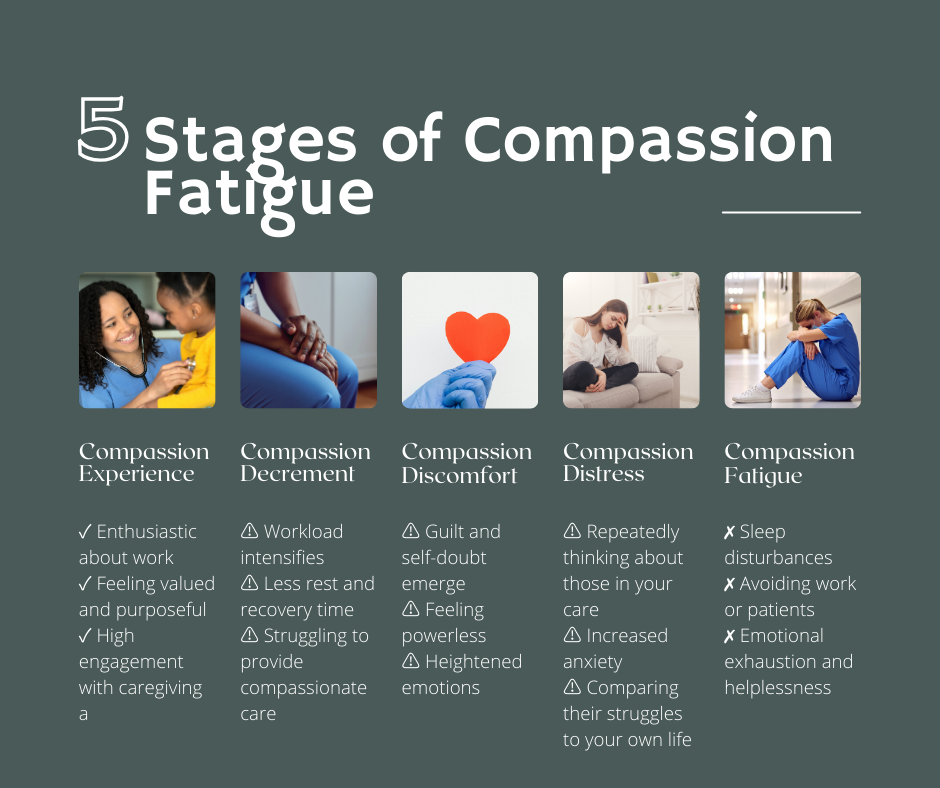
Research on nurses experiencing compassion fatigue has identified five distinct stages:
- Compassion experience period– characterized by positive, enthusiastic work and recognition of work value
- Compassion decrement period– marked by high workload intensity, lack of rest time, and feelings of being less able to provide compassionate care
- Compassion discomfort period– involving reflexive guilt, moral suffering, heightened emotions, powerlessness, and self-doubt
- Compassion distress period– characterized by repeated recall of patients’ conditions, emotional distress, social comparison (analogizing patient experiences to personal life), and underlying anxiety
- Compassion fatigue period– the final stage involving sleep disorders, deliberate avoidance of work and patients, role conflict, emotional exhaustion, and feelings of helplessness.
These stages are dynamic and cumulative, meaning people may move between stages depending on stressors and support. Early recognition at any stage can help prevent progression to more severe symptoms.
Who Is Most at Risk for Compassion Fatigue?
Compassion fatigue can affect anyone, but certain roles and traits increase risk. People in helping professions, such as healthcare providers, mental health clinicians, social workers, and first responders, are particularly vulnerable due to repeated exposure to trauma and distress. Research indicates that prevalence among frontline healthcare workers ranges from 40–80%, with those working in specialized hospice or palliative care experiencing heightened susceptibility.
Caregivers outside of formal professions are also at risk. Parents of children with complex needs, individuals caring for aging or ill loved ones, and those supporting partners through mental health or substance use challenges often carry a significant emotional load with limited support.
Highly empathetic individuals and people with their own trauma histories may experience compassion fatigue more quickly, especially if boundaries are difficult to maintain. Risk increases when support systems are limited or when caregiving demands feel constant and unavoidable.
Real-Life Examples of Compassion Fatigue
Compassion fatigue often becomes clearer through lived experience. While each situation is unique, some patterns show up repeatedly.
A nurse may notice emotional shutdown after repeated patient losses, finding it harder to connect despite wanting to care. A parent supporting a child with chronic illness may feel depleted, irritable, or disconnected after years of prioritizing others’ needs. A therapist might feel dread before sessions or a sense of detachment that wasn’t present earlier in their career.
These experiences are common and understandable responses to sustained emotional labor. Naming them can be an important first step toward support.
How Do You Recover From Compassion Fatigue?
Recovery from compassion fatigue focuses less on “pushing through” and more on restoring nervous system balance and emotional capacity. While strategies vary, several principles tend to help.
Re-establishing boundaries is often foundational. This may include clearer limits around work hours, emotional availability, or caregiving roles. Prioritizing rest and regulation—such as sleep, movement, and grounding practices—supports physiological recovery.
Psychological resilience—the ability to adapt and rebound from stress—has been shown to reduce compassion fatigue and protect against anxiety, depression, and emotional exhaustion. Active coping strategies, such as seeking social support, maintaining work-life balance, and engaging in self-care practices, are also associated with lower levels of compassion fatigue.
Many people benefit from talking with a mental health professional or trusted peers who understand caregiving stress. Reconnecting with meaning and compassion satisfaction, rather than focusing only on symptoms, can also support healing.
Recovery is not about caring less. It’s about creating conditions that allow care to be sustainable.
Can Compassion Fatigue Affect Mental Health Long-Term?
When unaddressed, compassion fatigue can contribute to longer-term mental health challenges. Ongoing emotional exhaustion may increase vulnerability to anxiety, depression, or trauma-related symptoms. Some people withdraw socially or feel increasingly disconnected from themselves and others.
Early recognition and support can significantly reduce these risks. Compassion fatigue is responsive to care, especially when addressed before it becomes deeply entrenched.
If emotional numbness, irritability, or exhaustion persist, reaching out for guidance can help clarify what kind of support may be most helpful.
When Should Someone Consider Professional Support for Compassion Fatigue?
Professional support may be helpful when compassion fatigue symptoms don’t improve with rest or self-care alone. This includes situations where emotional detachment affects relationships, work, or caregiving roles, or when stress feels constant and unmanageable.
Structured outpatient mental health support can be appropriate when compassion fatigue overlaps with burnout, trauma exposure, or co-occurring anxiety or depression. These settings allow people to receive care while continuing daily life, without assuming crisis-level need.
Exploring support options can be a way to protect long-term well-being, not a sign that someone has failed at caring.
Verify Insurance
If you or a loved one is struggling with compassion fatigue that impacts your ability to function in daily life, Monima Wellness is here. Let us help you verify whether your or your loved one’s insurance provider can offer financial assistance for care.
Call 858-500-1542 or Verify Insurance
Frequently Asked Questions (FAQs)
How do you fix compassion fatigue?
Compassion fatigue is supported by establishing boundaries, prioritizing rest, regulating the nervous system, and processing emotions. Psychological resilience and active coping strategies—such as seeking social support and maintaining work-life balance—can reduce symptoms. Professional support can help when symptoms persist or worsen.
What are the five stages of compassion fatigue?
Research has identified five stages: compassion experience period (initial engagement and motivation), compassion decrement period (reduced capacity due to high workload), compassion discomfort period (guilt, powerlessness, self-doubt), compassion distress period (repeated recall of distressing experiences, anxiety), and compassion fatigue period (emotional exhaustion, avoidance, sleep disturbances).
What are three signs of compassion fatigue?
Common signs include emotional numbness or reduced empathy, irritability or cynicism, and persistent physical fatigue that doesn’t improve with rest.
What are real-life examples of compassion fatigue?
Examples include nurses feeling emotionally shut down after repeated patient losses, parents caring for children with chronic illness feeling depleted and disconnected, therapists dreading sessions they once found meaningful, or caregivers experiencing sleep disturbances while repeatedly thinking about those in their care.
Is compassion fatigue the same as burnout?
No. Burnout is driven primarily by workload, systemic pressure, and organizational stress, while compassion fatigue is driven by emotional exposure to others’ suffering and trauma. Burnout develops gradually over time, while compassion fatigue can emerge more suddenly. They often overlap, especially in healthcare and caregiving roles.
References
Stoewen DL. Moving from compassion fatigue to compassion resilience Part 4: Signs and consequences of compassion fatigue. Can Vet J. 2020 Nov;61(11):1207-1209. PMID: 33149360; PMCID: PMC7560777.
Zhang J, Zou J, Wang X, Luo Y, Zhang J, Xiong Z, Zhang J. Clinical nurses’ compassion fatigue psychological experience process: a constructivist grounded theory study. BMC Nurs. 2023 Dec 19;22(1):487. doi: 10.1186/s12912-023-01665-3. PMID: 38114975; PMCID: PMC10729325.