
If you’ve been feeling stressed and feel like you’re falling short as a mom, know this: stress affects your nervous system. When stress is high, even deeply caring mothers may feel more reactive, impatient, or emotionally depleted. This is not a reflection of your values, love, or ability to parent. Becoming a “better” parent in these moments isn’t about trying harder or fixing yourself. It’s about building enough internal steadiness to begin responding differently.
For many women, chronic stress in motherhood overlaps with anxiety, maternal burnout, trauma, or postpartum changes. Healing that addresses both emotional health and nervous system regulation can help you begin to restore balance and groundedness. Remember, small, compassionate shifts can make a meaningful difference in how you show up for your family and, most importantly, yourself.
Key Takeaways
- Stress narrows emotional capacity, even in loving and attentive parents
- Regulating your nervous system matters more than perfect parenting
- Repairing after hard moments supports secure attachment
- Ongoing overwhelm may signal parental burnout, anxiety, or unmet support needs
If you or a loved one is struggling with parental burnout, you’re not alone. Contact Monima Wellness today to learn more about our outpatient programs for moms in San Diego.
Why Stress Affects Parenting So Strongly
Parenting while stressed is hard because stress directly impacts how your brain and body function. When stress becomes chronic, your nervous system stays in a heightened state of alertness. Your body is prioritizing survival over patience, creativity, and flexibility. In daily life, this can translate to snapping more easily, feeling emotionally numb, or becoming overly controlling just to get through the day.
The truth is, mothers often carry an invisible mental load—planning, anticipating others’ needs, managing emotions, and keeping family logistics together. Add in sleep deprivation, limited time for self-care, and the implied cultural pressure to “do it all,” and stress compounds quickly. For women who have experienced past trauma or attachment wounds, parenting can also activate older emotional patterns, which can unconsciously intensify reactions.
If this resonates, it doesn’t mean you’re a bad mom. It just means your system is overloaded.
At Monima Wellness, we help women explore how stress and trauma live in the body and find steadier ways to move through motherhood. Call today or let us help you verify that your insurance provider can provide financial assistance. We accept most major insurance providers.
How to Be a Better Mom When You’re Stressed
Being a better mom when you’re stressed begins with taking care of yourself, not forcing yourself to do more. Your ability to show up for others, including your children, improves when your nervous system feels safer and more regulated. That doesn’t always require long self-care routines or drastic changes—consistency matters more than intensity.
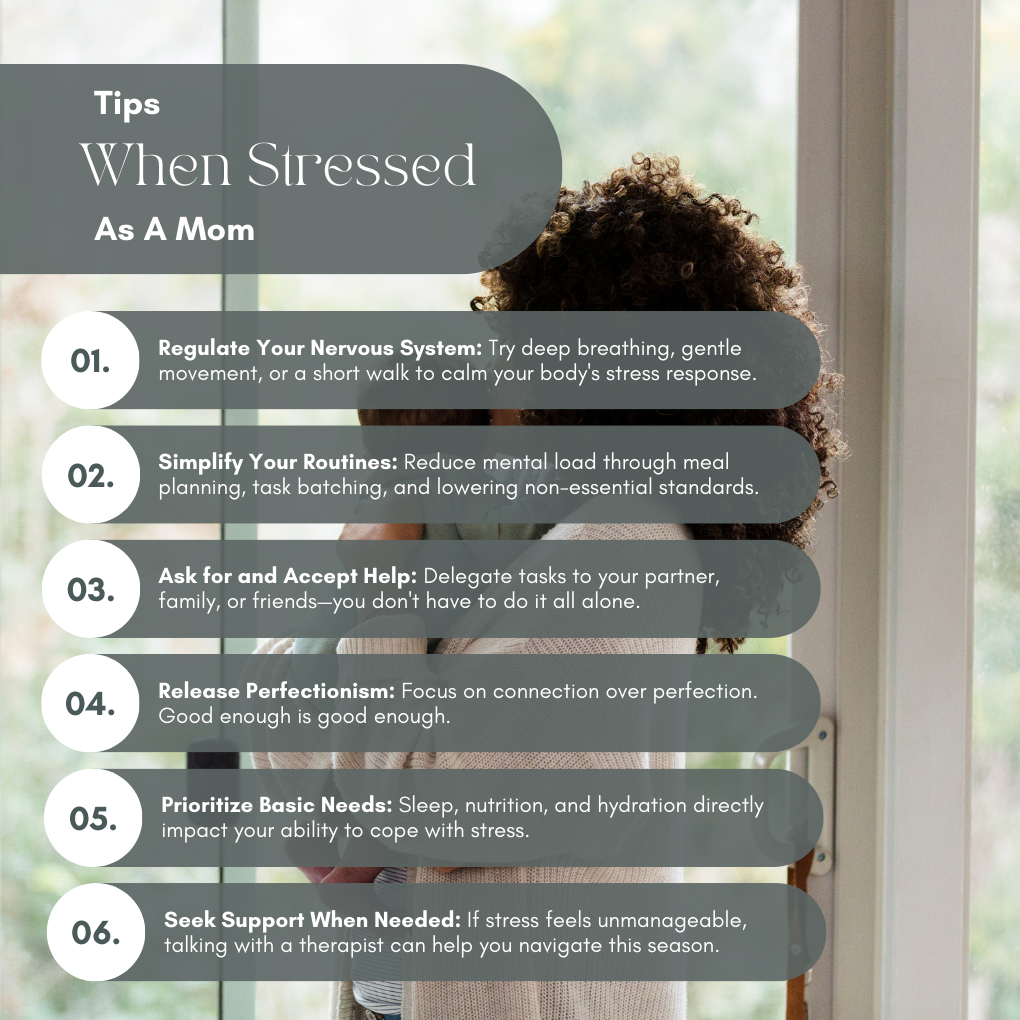
Healthy ways to begin supporting yourself include:
- Prioritizing grounding moments (slow breathing, stepping outside, gentle movement or meditation)
- Planning one small next step and asking for emotional support (instead of trying to power through)
- Lowering expectations during high-stress periods
- Naming stress internally instead of judging your reactions
- Focusing on repair after difficult moments rather than being perfect or avoiding mistakes
Research on parenting stress suggests that strategies like planning, acceptance, and seeking emotional support are common ways mothers cope with overwhelm.
If stress feels constant or overwhelming and impacts your ability to take care of yourself, it may help to explore a higher level of support. Intensive outpatient treatment can be beneficial for moms who need to maintain their daily lives and are also seeking more structured support.
How to Reduce Stress in Motherhood
Reactivity often shows up before we consciously recognize stress. Tight shoulders, shallow breathing, racing thoughts, or irritability are early signs that your system is overwhelmed. When stressors pile up within a short period of time, emotional reactivity tends to increase—especially when there hasn’t been enough time to recover between stressors. Beginning to notice these internal cues can help you take action before the stress escalates.
Helpful strategies for reducing stress include:
- Simplifying routines to reduce decision fatigue
- Building predictable moments of rest into your day
- Limiting overexposure to social media comparisons
- Asking for specific help rather than waiting until you’re depleted
If stress still feels high despite these changes, it may be helpful to explore more structured support. For moms who need more than weekly therapy alone, Monima Wellness provides outpatient care in San Diego that integrates trauma-focused therapy with mind-body approaches to support emotional regulation and holistic healing.
How to Manage Your Stress as a Stay-at-Home Mom
Stay-at-home moms face unique challenges and stressors, including isolation, lack of boundaries in their roles, and limited external validation. Specifically, the absence of clear “off hours” can make stress feel constant and inescapable.
Managing stress in a stay-at-home mom role can often mean:
- Creating a structure that supports you, not just your children.
- Prioritizing adult connection and conversation, whether with your partner or outside friends and family members.
- Redefining productivity beyond constantly working.
- Allowing rest to be purposeful, without needing to be “earned.”
Feeling overwhelmed as a stay-at-home mom isn’t a reflection of you as a parent—it’s a reflection of the intensity of this unpaid, emotionally demanding role. A therapist or outpatient mental health program can help you begin exploring how to take care of yourself and maintain your role as a parent. There’s room for both, and it’s okay to take a break.
How to Stop Being Uptight or Reactive as a Mom
Reactivity often shows up before we consciously recognize stress. Tight shoulders, shallow breathing, racing thoughts, or irritability are early signs that your system is overwhelmed. When stressors pile up within a short period of time, emotional reactivity tends to increase. Beginning to notice these internal cues can help you take action before the stress escalates.
Helpful tools to combat reactivity include:
- Pausing when you notice physical tension
- Using grounding techniques like temperature changes or breathing
- Practicing self-compassion after reactive moments
- Reframing reactivity as information, not failure
As mentioned earlier, repair always matters more than perfection. Apologizing, reconnecting, and regulating together actually teaches children emotional resilience. If reactivity feels frequent or intense, professional support can help uncover what your nervous system needs to feel safer.
Why Adjusting to Motherhood Can Feel So Hard
Many women struggle with the transition into motherhood, even when it is deeply desired. This adjustment is not just about caring for a baby — it often involves a profound shift in identity, relationships, expectations, and emotional capacity.
As Monima Wellness clinician Julia Paraiso, ASW, explains, “the transition to motherhood involves a physical, psychological, emotional, and social transformation.” She notes that clinicians often use the term matrescence to describe this process, likening it to adolescence as a long-term developmental stage rather than a single moment in time.
Cultural expectations can make this transition feel even harder. Many moms are taught that maternal instinct should appear immediately and that bonding, caregiving, and emotional fulfillment will come naturally. As Julia shares, “whether it’s through social media, other moms, or our own families, we’re often made to believe that the ‘maternal instinct’ will kick in and that caring for our newborns will come naturally and without any problems. But the reality is that for so many women, that’s not the case.”
When expectations don’t match reality, it can bring up shame or self-doubt. “A lot of moms don’t feel an immediate bond with baby, lack motivation to get out of bed to tend to their needs, or even experience regret and anger after having a child,” Julia notes. Acknowledging these experiences without judgment can be an important step toward self-compassion and feeling less alone.
As Julia explains, “having a hard time with the transition to motherhood does not make you a bad mom.” It reflects the reality of a major developmental transition, and with the right support, that process can feel less isolating and more manageable.
When Stress in Motherhood Becomes a Mental Health Concern
Stress becomes a mental health concern when it’s persistent, intense, or interfering with daily functioning. Signs may include ongoing anxiety, emotional numbness, rage, burnout, or feeling disconnected from yourself or your children. In one longitudinal study tracking postpartum women from about six weeks to six months after delivery, stress levels decreased over time, but were consistently higher among women experiencing depression or anxiety symptoms—suggesting that ongoing overwhelm can be a meaningful signal to seek support.
Women with trauma histories, postpartum changes, or limited support may be especially vulnerable. You don’t need a diagnosis to deserve help. Early support can prevent stress from becoming more entrenched and can restore emotional balance more effectively than waiting until you’re at a breaking point.
What Support Options Can Help Stressed Mothers?
Support for stressed mothers exists on a spectrum and should fit into real life. Options may include individual therapy, trauma-focused approaches, somatic-based care, or structured outpatient mental health programs that allow you to remain present for your family.
Outpatient care can be especially helpful when stress overlaps with anxiety, depression, or burnout and when weekly therapy alone isn’t enough. Exploring your options doesn’t mean committing to treatment—it means gathering information so you can make informed choices when you’re ready.
Begin Your Healing Journey
If motherhood feels heavier than you expected or stress is starting to affect you in a way that feels overwhelming, you don’t have to face it alone. Contact our team today to learn more about our supportive women’s mental health programs. Begin healing in a community of like-minded women who get it.
At Monima Wellness, you’re never alone.
Frequently Asked Questions (FAQs)
How can I reduce stress in motherhood?
Reducing stress involves supporting your nervous system through rest, simplification, emotional regulation, and meaningful support, not just better time management.
How do I manage stress as a stay-at-home mom?
Structure, adult connection, realistic expectations, and external support can help counter isolation and constant responsibility.
How can I stop being so uptight as a mom?
Uptight or reactive behavior is often a sign of nervous system overload. Learning to recognize early stress cues and practicing repair can help.
Why am I having such a hard time adjusting to motherhood?
Adjustment difficulties are common and often linked to identity shifts, unmet support needs, hormonal changes, or trauma history.
References
Wang Y, Gu J, Gao Y, Lu Y, Zhang F, Xu X. Postpartum stress in the first 6 months after delivery: a longitudinal study in Nantong, China. BMJ Open. 2023 Oct 21;13(10):e073796. doi: 10.1136/bmjopen-2023-073796. PMID: 37865410; PMCID: PMC10603468.
Schilling, O. K., Gerstorf, D., Lücke, A. J., Katzorreck, M., Wahl, H.-W., Diehl, M., & Kunzmann, U. (2022). Emotional reactivity to daily stressors: Does stressor pile-up within a day matter for young-old and very old adults? Psychology and Aging, 37(2), 149–162. https://doi.org/10.1037/pag0000667
Kim, P. (2021). How stress can influence brain adaptations to motherhood. Frontiers in Neuroendocrinology, 60, 100875. https://doi.org/10.1016/j.yfrne.2020.100875